 HIXOR
How to read the assessment report and decide what to do first — a fictional metal-parts manufacturer
Using the published sample report (the example of a fictional company), this page explains the report's structure, how to read it, and how to decide what to do first.
Key points
- Sample (fictional). This page exists to show the shape of an assessment report and how to read it. It is not the case of a real company, and it carries no post-implementation results or improvement outcomes
- The report is made of: the breakdown of answers (done / partially done / not done / not confirmed / not applicable), priority risks, findings by area, the items to check under "not confirmed", a 30/60/90-day plan, and a SECURITY ACTION section
- The recommended reading order is: ① the breakdown of answers, ② "not confirmed", ③ priority risks. Do not treat "not confirmed" as "not done" — check it inside the company first
- The assessment organises your answers. It includes no technical verification, certification, or guarantee
An assessment report is read in this order: look at the breakdown of answers, check the "not confirmed" items first, and then work down the priority list. Using HIXOR's published sample report (the example of a fictional company), this page explains the report's structure, how to read several of its findings, and how an owner decides what to do first. It includes no results of having carried the plan out, and no improvement outcomes.
About this page: not a real company
This page is based on the sample report (PDF, 10 pages). The sample exists so you can check the format; every piece of information, every figure and every answer in it is fictional. It is an example built from answers to the assessment sheet — no inspection of actual equipment, no vulnerability scan, no penetration test, and no guarantee of safety was performed. This page uses only what is written in that sample, and adds nothing that is not written there.
The fictional company's setup (as written in the sample)
The company in the sample is "Sample Manufacturing Co., Ltd.". The setup written in the sample is as follows.
| Item | Contents of the sample |
|---|---|
| Industry | Metal parts machining and manufacturing |
| Employees | 6–20 (fictional setting: 16) |
| Business devices | 6–20 (fictional setting: 14) |
| Main data storage | An in-house NAS and cloud services together |
| Business-type branches | Remote connections present / a production-equipment network present |
| Website | No web operation covered by the assessment |
| Method of checking | Assessment sheet only / no technical verification |
Anything beyond this (the company's location, founding, clients, staff in charge, and so on) is not written in the sample, so it is not on this page either.
The report's structure: what is written where
After the cover, the sample report consists of chapters 01 to 08.
| Chapter | Contents |
|---|---|
| Cover | The assessment method (assessment sheet only / no technical verification); the number of items checked (31 items + 4 business-type items) |
| 01 About this report | The premises, how to read the results (the meaning of the five answers), and the limits of the assessment |
| 02 Results summary | The breakdown of answers for the basic 31 items |
| 03 Priority risks | The items to advance first, and the basis for each |
| 04 / 05 Findings by area | Each answer and finding for the 31 items and the 4 additional business-type items |
| 06 Not confirmed, and the improvement plan | What to check inside the company first; the 30/60/90-day plan |
| 07 SECURITY ACTION | The check concerning SECURITY ACTION (recorded separately from the 31 items) |
| 08 Next steps | What to do next, the scope of the service, and the limits of the assessment |
How to read the results summary: the breakdown, not a score
The answers for the sample's basic 31 items are: done 3, partially done 10, not done 15, not confirmed 3, not applicable 0. The four conditional questions about remote connections and the factory are tallied separately.
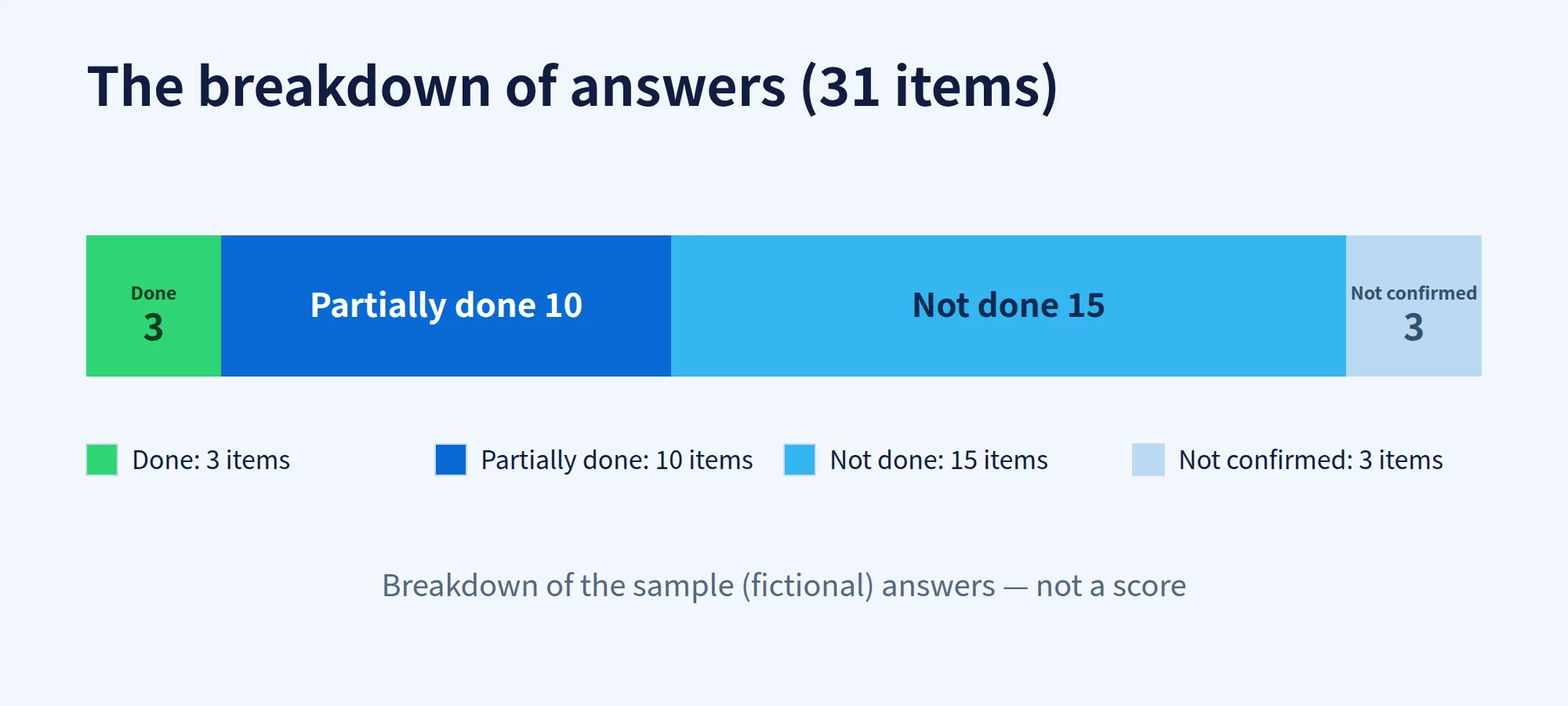
Three points matter when reading these numbers.
- It is not a score. The sample shows the breakdown of answers, not a total score. "15 items not done" does not mean "15 weaknesses were found"; it means "that was the answer given"
- The answers are self-reported. "Done" means "reported as done". It does not mean the actual settings were inspected
- "Not confirmed" is not "not done". "Not confirmed" marks the items the person answering did not know. The sample states explicitly that "not confirmed" items are not to be treated as decided "not done"
How to read the priority list: one row at a time
The priority list in chapter 03 gives priority, centred on the items answered "not done", to the ones most likely to stop the business or lose data. The priorities here are an initial evaluation from the interview: they do not mean that HIXOR technically discovered an intrusion, a failure, or a misconfiguration.
Each row is made of an "item ID", the "basis in the answers", and "what to do first". Here are four of the sample's findings, read as examples.
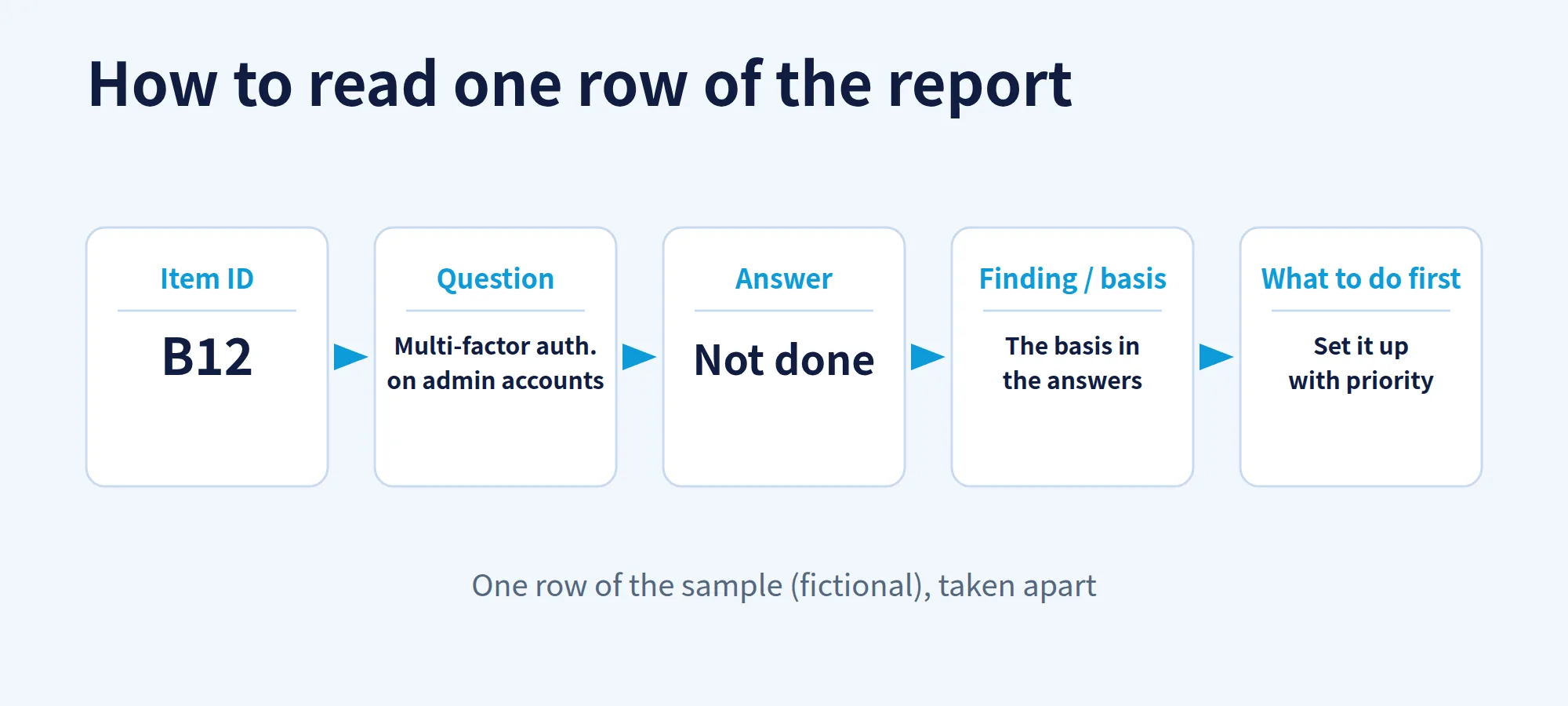
| Item | Basis in the sample's answers | Commentary (HIXOR) |
|---|---|---|
| B12 | Answered that MFA on administrator accounts is not in place | Administrator accounts can add users and change permissions. Because the impact of a takeover is large, whether multi-factor authentication is in place is an item to check with priority |
| B16 | Answered that no procedure exists for disabling accounts at departure or transfer | Check that no unused accounts remain, and decide the procedure and the person responsible for disabling them |
| B25 / B27 | Answered that separate storage and restore tests are not in place | Not just taking backups, but keeping them in a separate place and testing that they can actually be restored |
| B22 | Answered that bank-detail changes are not confirmed through a separate channel | Do not judge a notice of changed invoices or bank details by email alone; confirm through a separate means, such as a known phone number |
The priority list has further rows; these four are kept as reading examples. For the production-equipment network item (M01), the report says that, considering the risk of equipment stopping, the company's own person in charge should check the connection state.
Handling "not confirmed": don't assume — check inside the company
The first half of chapter 06 carries "information that needs checking first": a table of what the client checks inside their own company for the items answered "not confirmed".
| Item | What the client checks inside the company |
|---|---|
| B10 | Whether the settings allow the management console to be reached from outside |
| B14 | Whether the default passwords of the NAS and router have been changed |
| B28 | Whether there is a person who receives suspicious-login notifications |
| M02 | How the equipment maker's remote connections are approved |
When checking, secrets themselves are not requested — no passwords themselves, and no images of VPN details or connection settings (B14, M02). For B14, for example, only whether the default passwords of the NAS and router "have been changed" is checked; the passwords themselves are never asked for.
Deciding what to do first: three questions
What the sample report carries is the material for the owner to decide with. What to actually do first is the owner's decision. Using the sample, here is one way to decide. This is HIXOR's commentary, not the wording of the sample report itself.
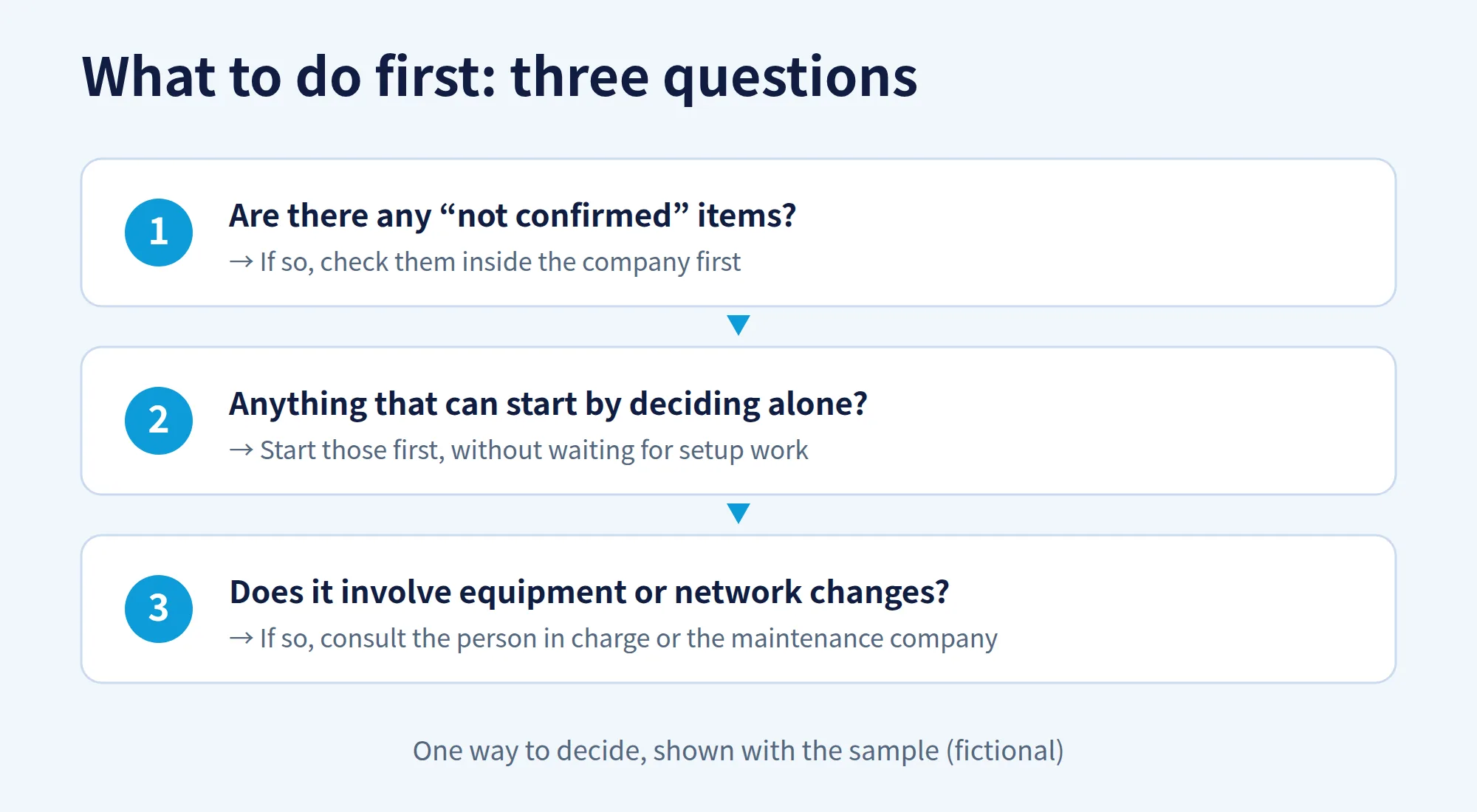
- Are there any "not confirmed" items? If so, check them inside the company first. Setting priorities while things are unknown risks getting the order wrong
- Is there anything that needs no setup work and can start by deciding alone? Rules such as deciding who disables accounts when someone leaves, and confirming bank-detail changes through a known number, can start without waiting for setup work
- Does it involve changes to equipment or the network? If it does, the work can stop the business, so confirm the scope and impact with the equipment person in charge or the maintenance company before proceeding
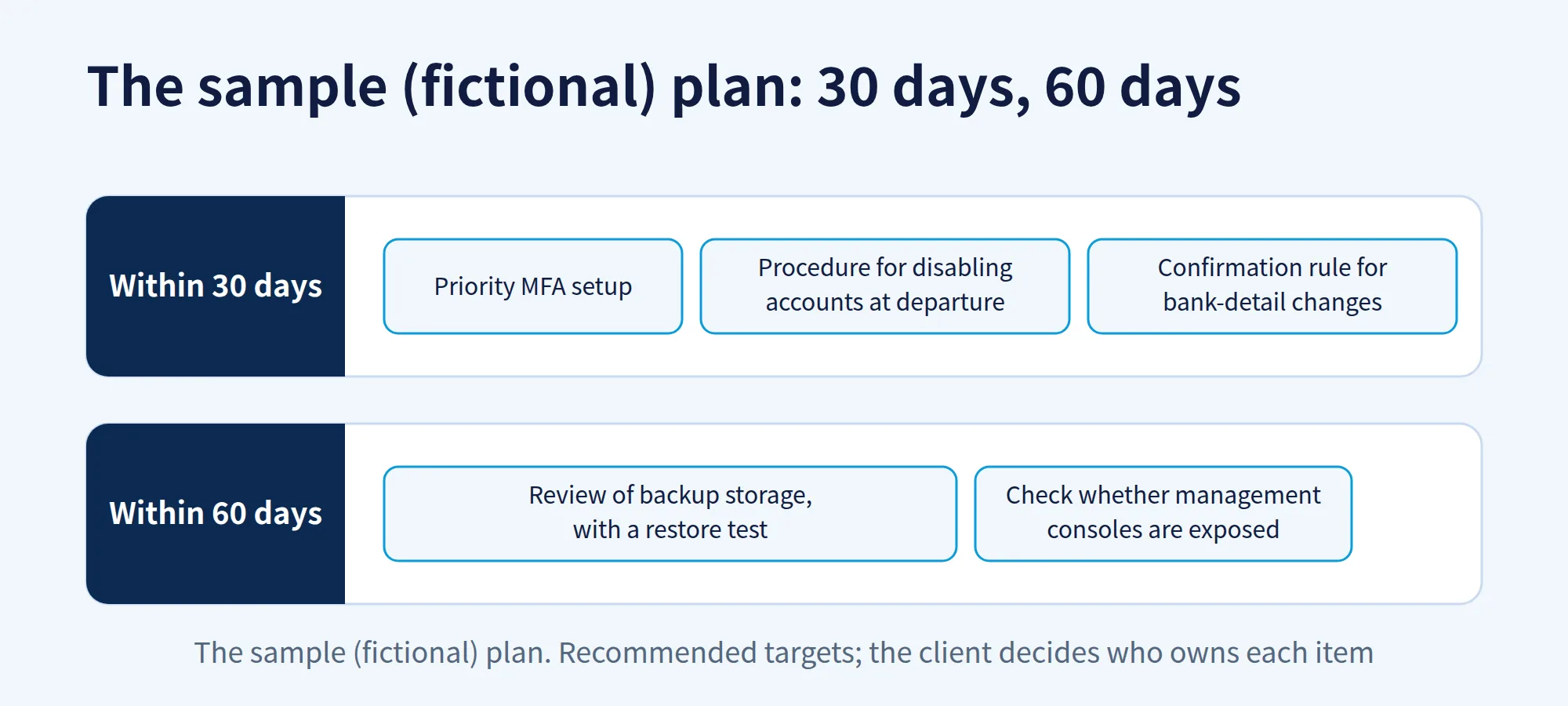
The sample report's 30/60/90-day plan follows the same thinking. Of the sample's plan, the first 30 days are "priority MFA setup, a procedure for disabling accounts at departure, and a confirmation rule for bank-detail changes"; the first 60 days are a review of how backups are stored plus a restore test, and a check of whether management consoles are exposed. Who owns each item is decided by the client — management, the IT person, the equipment person — and the plan is stated as recommended targets.
Note that this sample carries no results from after the plan was carried out. There is no "we did this, and so this happened" story on this page.
The relation to SECURITY ACTION: a self-declaration, not a certification
Chapter 07 carries the check concerning SECURITY ACTION, recorded separately from the 31 items. In the sample, G01 to G04 (carrying out the IPA's 25-item self-assessment, setting a basic policy, publishing the basic policy, completing the self-declaration) are all answered "not done".
SECURITY ACTION is the IPA's self-declaration scheme. The IPA does not certify it. The sample report also states that HIXOR's 31 items are not a substitute for the IPA's official 25 items, and that it does not present the IPA as having examined or certified security capability. The procedure is set out in SECURITY ACTION One Star and Two Stars: How to Declare and What to Prepare.
What the assessment does not include
The sample report explains that the assessment organises the state of measures and the issues, based on the client's self-reported answers. The following are not included.
- Technical verification; investigation of logs
- Checking the settings of actual equipment; vulnerability scans; penetration tests
- Setting up MFA on your behalf
- Granting an official certification; guaranteeing that you are safe; guaranteeing that no incident will occur
Countermeasures after the assessment are quoted separately, depending on their content.
Check your own company's state
To get a rough picture of your own company's state, there is the free security self-check (25 questions, about 3 minutes). Answers are processed only inside your browser. The result is a breakdown of "done", "not done" and "don't know". Like this page's "not confirmed", read "don't know" as an item to check first. How to read the results is set out in You can check your company's security state for free.
Open the sample report / the assessment's contents and price
The whole report can be checked in the sample report (the example of a fictional company). An actual report is prepared from the results of an interview and a review of your current posture.
The Security Assessment is for companies, at a fixed price (¥30,000 excl. tax; ¥33,000 incl. tax). It proceeds in four steps: an inquiry (email / chat); confirmation of the quotation and order form (the amount is fixed before work starts); an interview and a review of your current posture; and delivery of the assessment report and a prioritised improvement list. Capacity is a guide of up to two cases a month. Please ask for the current availability. How to advance the company's measures as a whole, and in what order, is set out in Small business cybersecurity: where to start.
Check your understanding
Q1. Is "Sample Manufacturing Co., Ltd." on this page a real company?
Answer: No. It is a fictional company that appears in HIXOR's published sample report; the company, the figures and the answers are all fictional. This page is not the case of an actual client.
Q2. The report says "not done: 15". Does that mean 15 weaknesses were found?
Answer: No. It means 15 items were answered "not done" on the assessment sheet. It does not mean HIXOR technically found weaknesses.
Q3. How are "not confirmed" items in the report handled?
Answer: They are not treated as decided "not done"; they are checked inside the company first. Priorities are decided from what the checking establishes.
Official information and sources
- HIXOR, "Assessment report sample" (PDF; format dated November 11, 2026) https://hixor.jp/static/reports/sample-security-assessment-report-v11c-2026-11.pdf / entry page https://hixor.jp/en/services/security-assessment/sample-report/
- HIXOR, "Security Assessment" and "How the Assessment Is Performed" (viewed November 28, 2026) https://hixor.jp/en/services/security-assessment/ / https://hixor.jp/en/services/security-assessment/methodology/
- IPA, "SECURITY ACTION" (a self-declaration scheme; the page states that the IPA does not certify it; viewed November 28, 2026) https://www.ipa.go.jp/security/security-action/sa/