 HIXOR
Small business cybersecurity: where to start — incident readiness and staff training
Key points
- Start with two pillars, not products: incident readiness (decide the first steps in advance) and staff training (more people who notice and report)
- Underneath both, keep the foundation running: prompt updates and patches, strong non-reused passwords with multi-factor authentication, least-privilege accounts, offline backups, and routine logs
- The starting order: contact list first, then write the first-response procedure down, then an annual training plan, then check the foundation, then one tabletop exercise
- One pillar alone is not enough: readiness without training finds incidents late, and training without readiness leaves the first response improvised
Small business cybersecurity does not start with buying products. It starts with two pillars, built in order. Pillar one is incident readiness: deciding in advance who does what in the first hours after something happens. Pillar two is people: staff training, so more people can spot something wrong and report it instead of handling it alone. Underneath both sits a foundation of basics — software updates, password management, and backups kept offline, away from the network. This article lays out the whole picture and the order to build it in, as one plan.
The whole picture: two pillars and a foundation
Most companies start by asking what to buy. The structure in the guidance from Japan's IPA — its security guidelines and incident response guide for small businesses — is not about products. It is about how the preparation fits together, on the assumption that incidents cannot be prevented completely: (1) decide the first moves before anything happens, (2) raise the judgement of the people who handle systems every day, and (3) keep the basic technical measures running underneath. Seen in these three layers, what your company is missing becomes visible.
Below, each pillar is made concrete, and the article closes with the order to start in. Detailed procedures live in the dedicated articles for each pillar.
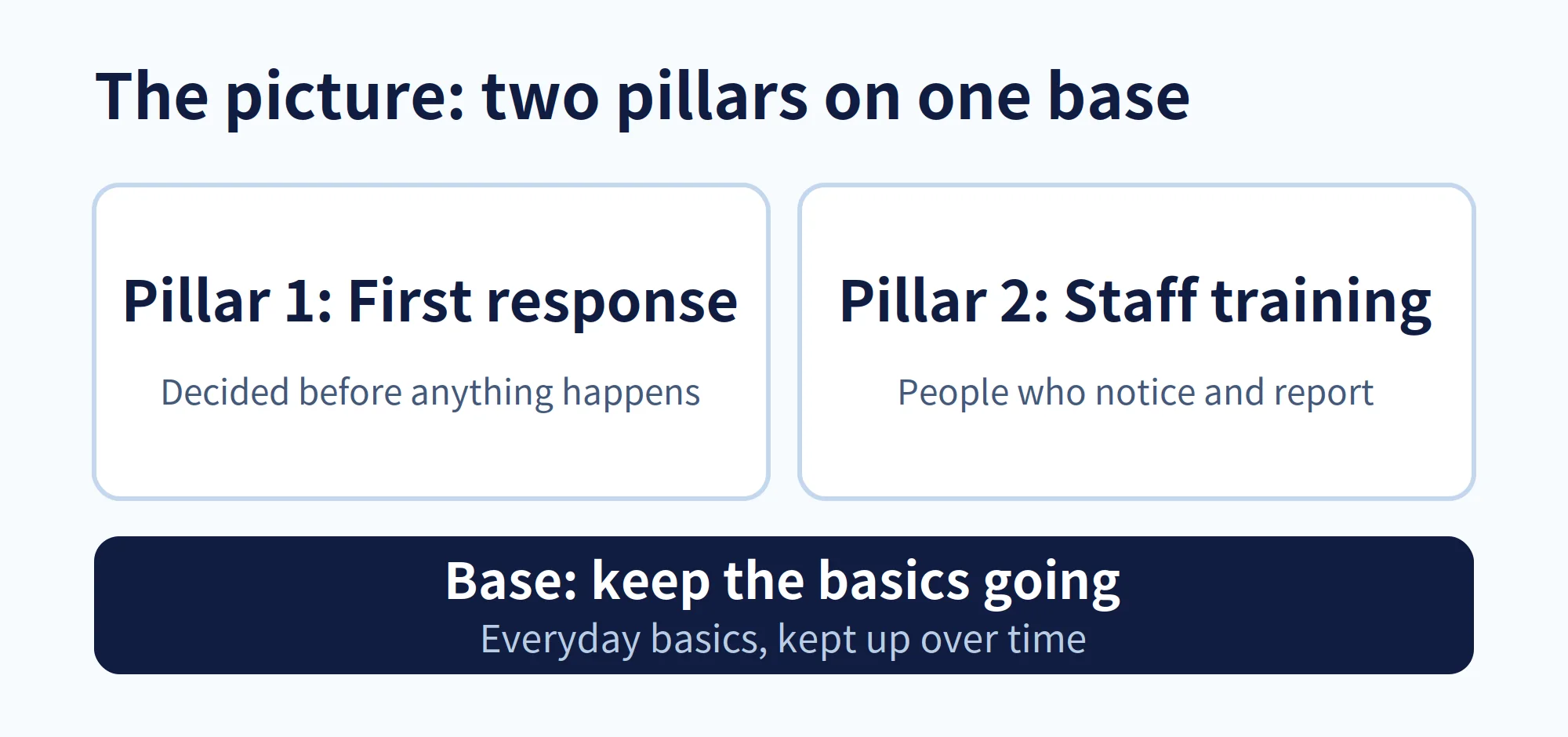
Pillar 1: Incident readiness — decide the first steps in advance
What you decide here is procedure, not technology. Who does the discoverer report to? How does the manager escalate to the owner? How is an infected device disconnected from the network — without carelessly cutting its power? Where are the outside contacts: police, the IPA, the Personal Information Protection Commission? Decide these in peacetime, and ideally print them out and keep them where people can reach them.
The IPA guide organises the response as detection and receiving reports, first response, reporting and disclosure, then investigation and recovery — a flow that works as the blueprint for readiness. The concrete steps, scene by scene, are in ransomware: first steps for a small business.
Pillar 2: Staff training — more people who notice and report
The second pillar is people. Japan's National Police Agency, in its ransomware guidance, stresses that not only owners and IT staff but every employee needs correct knowledge put into practice, and that in-house security education should be strengthened. Two habits do most of the work: do not open suspicious attachments, and report anything abnormal instead of deciding alone. Together they reduce both how often incidents start and how far they spread.
Training works best as a rhythm, not a one-off event: at joining, one full session a year, and short reminders in between. What a small company should cover, and how often, is set out as an annual plan in employee security training for small companies: what, how often.
The foundation: keep the basics running
Under the two pillars sit everyday basics. The police ransomware guidance names these representative measures:
- Apply updates and security patches for VPN equipment, operating systems, and software promptly, leaving no known vulnerabilities open
- Use passwords that are hard to guess and never reuse them; combine them with stronger authentication such as multi-factor authentication
- Keep account access permissions to the minimum necessary, and manage administrator privileges strictly
- Take backups frequently and store them offline, disconnected from the network — an always-connected backup can be encrypted along with everything else
- Collect logs routinely, so an investigation has something to work from
None of these is set-and-forget. Their value is in being continued, alongside the two pillars, starting wherever you can.
The order to start in
- Decide the contact list and "who do I tell first?" (costs nothing; can be done today)
- Write the first-response procedure down — adapt the IPA's free guide to your company, or use a kit with the forms already structured
- Make an annual training plan — joining + yearly + short reminders, in a form a small company can sustain
- Check the foundation — updates, passwords, permissions, backups, logs, one at a time
- Run one tabletop exercise — "a ransom note just appeared on screen": can everyone follow the procedure?
The logic is: fix first whatever would hurt most on the day of an incident. Readiness and training both pay off before any product purchase. You do not have to build everything at once — but with only one pillar, the gap in the other is where damage spreads. Readiness without training means incidents are found late; training without readiness means the first response is improvised even when someone does notice.
If you want both pillars prepared together

Company Set (Security Training-in-a-Box + Incident First-Response Cards & Runbook Pack) — ¥42,800 (tax included)
A bundle of the forms and materials for both pillars in this article — incident readiness and staff training. Bought separately the two kits total ¥49,600; the set is ¥42,800. The incident side includes six first-response cards, a first-response timeline, a policy template, report forms, and tabletop exercise scenarios — 7 PDFs, 23 pages, plus Word and Excel files — so the plan does not have to start with designing documents from zero.
Start with one half (alternatives): incident readiness only — Incident First-Response Cards & Runbook Pack (General Edition), ¥19,800 (tax included); staff training only — Security Training-in-a-Box, ¥29,800 (tax included). See the shop guide for how buying, downloading, and printing work.
Review your current posture with 25 questions. Runs in your browser only.
See the latest threat intelligence