 HIXOR
Employee security training for small companies: what, how often
Key points
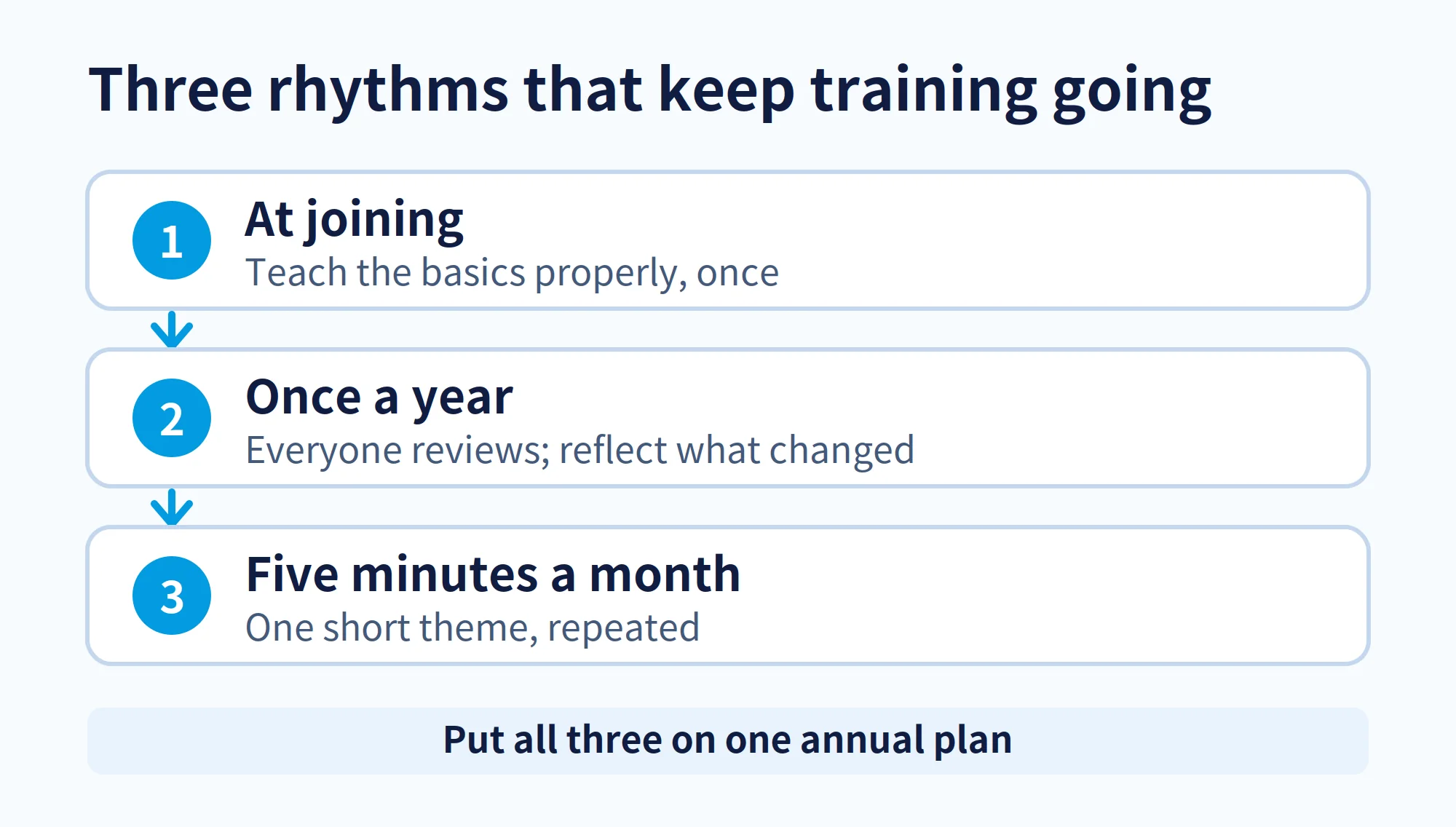
- Training runs sustainably in three layers: at joining, once a year, five minutes a month
- The basics — passwords, suspicious email, handling information, who to contact — are enough to start
- IPA's self-diagnosis (item 20 covers employee education) and free materials form the foundation
- Keeping a record of date, topic and participants is what lets you explain training to partners
For a small company, employee security training works with three layers combined: once when someone joins, once a year for everyone, and a five-minute reminder every month. The content is not advanced technology. It is basic work habits: how to handle passwords, what to do with a suspicious email, and who to contact when something happens. This article shows how to build an annual plan using free materials from Japan's IPA (Information-technology Promotion Agency), with example monthly topics.
The model: at joining, once a year, five minutes a month
A single long session once a year does not make safe habits stick. IPA's "Five-Minute Information Security Self-Diagnosis" asks, in item 20, whether the company provides security education and awareness-raising for employees — and it asks it as an ongoing practice. Its commentary explains that repeated awareness-raising is effective, and that training opportunities should be held regularly and also when needed, for example after an incident.
A pattern a small company can sustain has three layers. First, at joining: explain the work rules and the reporting route on day one. Second, once a year: a main session for everyone (around 45 to 60 minutes) covering the basics. Third, every month: five minutes at the start of a regular meeting, on one topic only. This keeps preparation light, and it removes the "did we actually do training this year?" problem. If you want to plan training as part of a wider programme, see also where to start with cybersecurity for a small business.
What to teach: five basic topics are enough
Start with five topics. (1) Passwords: make them long, never reuse them, and use multi-factor authentication where available. (2) Suspicious email: do not casually open unexpected attachments or links, and share and report them inside the company — this matches items 6 and 7 of the IPA self-diagnosis. (3) Rules for storing and taking out important information. (4) Everyday basics such as locking your screen when you step away. (5) Who to contact, and what to do first, when something happens.
As a foundation, IPA has long presented its "Five Rules of Information Security" for small businesses: keep operating systems and software up to date; use antivirus software; strengthen passwords; review sharing settings; and learn about current threats and attack methods. In version 4.0 of IPA's SME guideline, a sixth item — take backups — was added, making it six rules. If you are unsure what to teach, work through these items in order.
Monthly five-minute topics: a 12-month calendar
Keep each monthly reminder to five minutes and one topic. For example: April, password review for the new business year; May, spotting suspicious email and where to report it; June, USB drives and taking data out; July, social media posts before the summer holidays; August, absence cover and handovers; September, checking backups; October, operating system and app updates; November, scam email dressed up as year-end sales; December, public Wi-Fi while travelling; January, fake invoice email in the new year; February, fake tax-season websites; March, account clean-up for leavers and transfers. Adjust the list to your busy seasons and to suspicious messages your company actually received. What matters is deciding the topics for the year in advance.
This is also the honest limit of the free approach. Choosing topics, preparing a short explanation each month, and keeping records is small work each time, but it steadily uses the organiser's hours across a year. If you would rather skip the material-making, a prepared set such as the Security Training in a Box kit, with slides, a presenter script, tests and record forms ready to use, is one option. Either way, compare the time it takes to make materials yourself against the cost of buying them, and decide on that basis.
Starting free: how to use IPA's materials
To start without spending, IPA's published materials are the foundation. Its Information Security Guidelines for SMEs consist of a management volume and a practice volume, with free appendices including the "Five-Minute Information Security Self-Diagnosis" (in PDF and Excel) and a template information security handbook. The method is simple: work through the 25 diagnosis items, and assign your weak items — not just item 20 on education — to the annual session and the monthly topics. Each item is answered on a simple scale (done / partly done / not done / don't know), so an owner and the person in charge can finish it together quickly.
One caution: free materials are ingredients, not a finished in-house course. They only become training your staff can act on once you write in your own contact points, reporting procedure, and the names of the services your company uses. Skip that step, and even excellent materials will not help anyone act on the day something goes wrong.
Keep records: proof that training happened protects the company
Training can only be explained to outsiders if there is a record. Six items are enough: the date, the topic, the presenter or organiser, the participants, the materials used, and the result of a short comprehension check. Business partners increasingly ask about training in their check sheets, and a record kept at each session carries far more weight than one reconstructed in a hurry.
The comprehension check does not need to be a formal exam. A few questions per topic, reviewed together on the spot so common misunderstandings are shared, serves as both record and revision. The point is not to grade employees; it is to find the topics that did not land, and feed them into next month's reminder.
Summary: start with a one-page annual plan
The realistic route for a small company is a small, repeatable pattern — at joining, once a year, five minutes a month — built on IPA's free materials, with your own contacts and procedures written in. The first step is a one-page plan: twelve monthly topics and a date for the annual session. Once that page exists, the rest is simply running it and keeping the record each time.
About the ready-to-use version
Security Training in a Box ¥29,800 (tax included)
A ready-made set for running the annual plan in this article: three slide courses (all staff / new joiners / managers, PDF + PowerPoint), a presenter script, comprehension tests, attendance and report forms, and an annual training plan sheet. Licensed for unlimited use inside your company.
Review your current posture with 25 questions. Runs in your browser only.
See the latest threat intelligence