 HIXOR
Never act on an 'urgent' payment order from the boss without checking — defences against CEO impersonation fraud
Key points
- If an instruction arrives in the president's or a manager's name — a transfer, creating a LINE group, account details — do not reply. Verify with the person directly, by a method other than email, using contact details you already hold: a business card, your address book
- Never decide a transfer alone — two or more people check and approve. Treat 'urgent' and 'keep this from the others' not as reasons to skip confirmation, but as warning signs
- Since December 2025, emails in a company president's name asking staff to 'create a LINE group and send back the QR code' have arrived in waves. IPA received 106 consultations about this pattern in the roughly three months to 10 March 2026
- Voices and video can also be faked. The Tokyo Metropolitan Police Department advises re-confirming important instructions through the official, published contact point
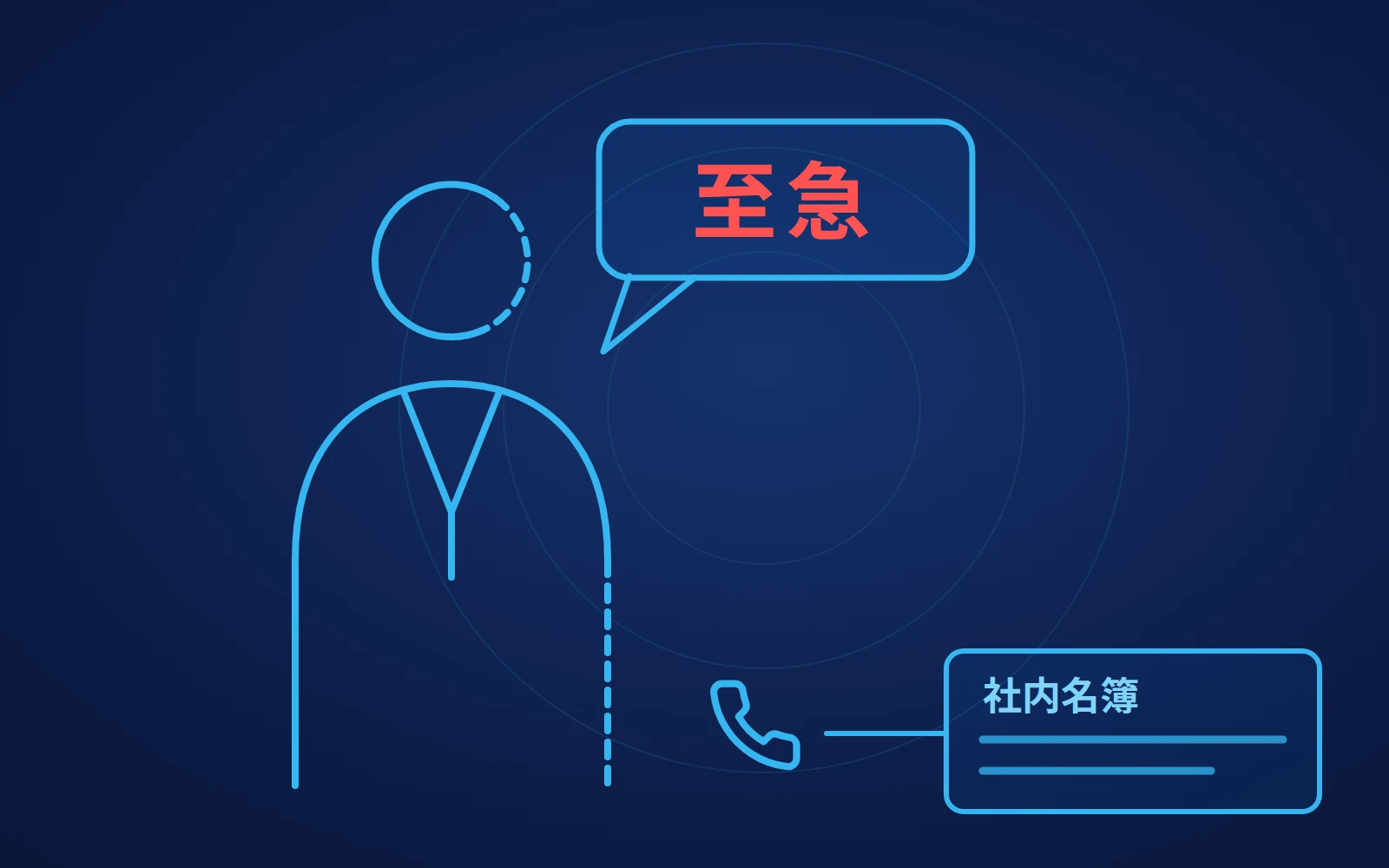
If an instruction arrives from the president or a manager — an "urgent" transfer, or "create a LINE group and send me the QR code" — do not reply to that email. Verify with the person directly, through contact details you already have registered, by a method such as a phone call or in person. And do not carry it out until a second person in charge has approved it with you. Being "urgent" is not a reason to skip confirmation; treat it as the signal to confirm. That is the centre of the defence against CEO impersonation fraud (in Japanese, the "fake president" fraud). The National Police Agency, the Tokyo Metropolitan Police Department and IPA all call for confirmation by a method other than email, and for reviewing internal transfer rules. This article explains the flow of the pattern, cases where voices and video are faked, three rules to decide inside the company, and what to do if you have already followed such an instruction. Fraud that impersonates a supplier — invoices and payment-details changes — is covered in a separate article.
What CEO impersonation fraud is: fake internal instructions that divert money to a fake account
CEO impersonation fraud is a fraud in which fake emails impersonating a company's executives are sent to employees, made to look like work instructions, to make them transfer money to the attacker's account. The National Police Agency calls it the "fake president" fraud and warns about it as one form of business email compromise (13 February 2026). IPA classifies it as "Type 2: impersonation of executives and similar" among the business email compromise patterns. It is also called "CEO fraud".
According to IPA, this type tends to target departments that manage money, such as finance and accounting staff. Wording that pretends to be an enquiry from management — "I have a confidential matter to discuss", "do you have a little time to talk about something" — has also been confirmed.
Company size is no reason for safety. The LINE group pattern described below is sent to company email addresses published on the internet and the like, and to companies' own mailing lists (National Police Agency, IPA). If an address is published, the pattern can reach any company.
The wave of "create a LINE group" emails: four stages
Since December 2025, emails using real presidents' and companies' names, asking for a LINE group to be created, have arrived in waves. The flow of the pattern, which the National Police Agency, the Tokyo Metropolitan Police Department and IPA are warning about, is as follows.
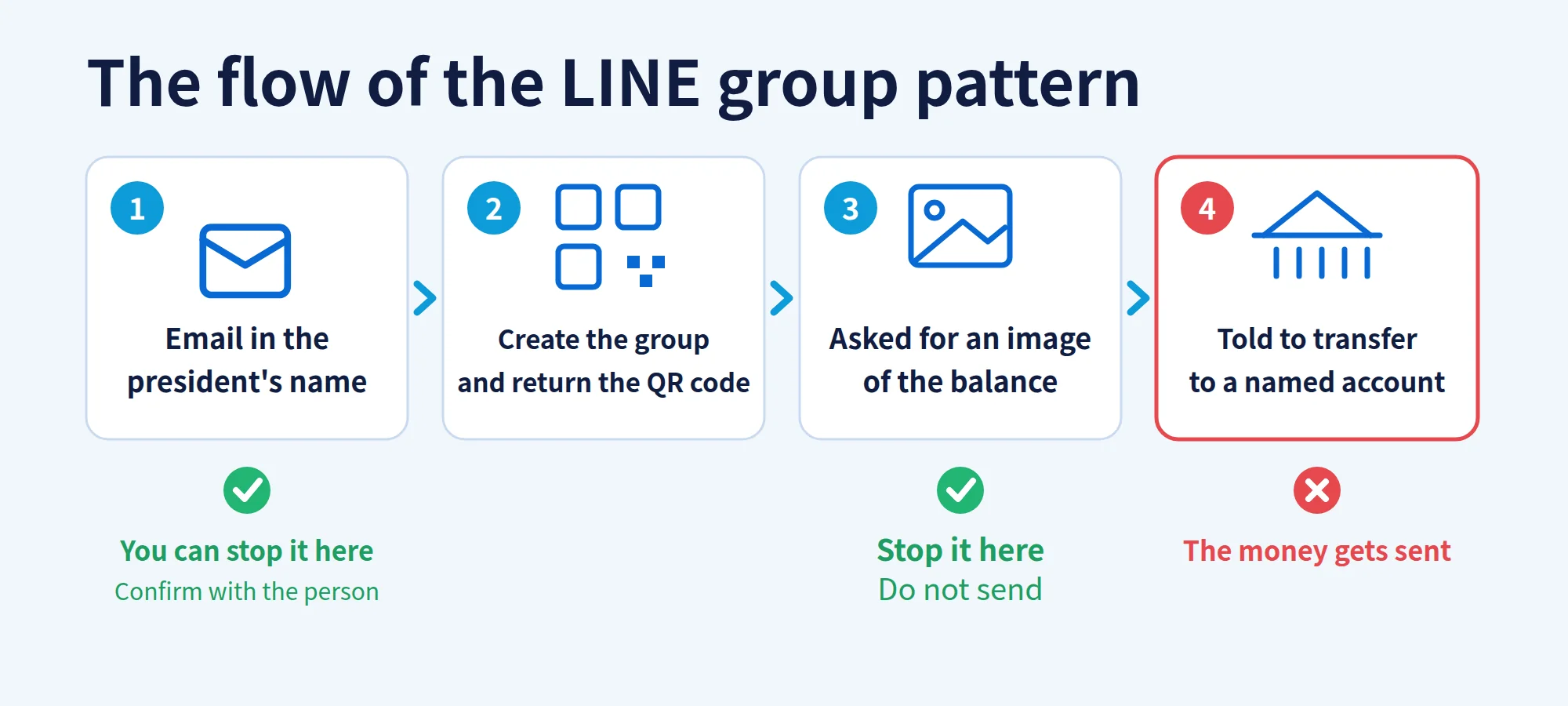
- An email arrives in the name of the president or an executive. The content looks like a work instruction, such as "to handle a business project" (Tokyo Metropolitan Police Department, National Police Agency).
- You are asked to create a LINE group and send back the invitation QR code. Some examples say "do not let anyone else into the group" (IPA). In some cases you are also instructed to put the staff member who holds transfer authority into the group (National Police Agency).
- Inside the group, you are asked to state the account balance. Some examples ask for an image of the account balance (National Police Agency, LINE).
- You are instructed to transfer money to a designated account — "please make a payment to a supplier on my behalf", "business funds are urgently needed", and similar. The Tokyo Metropolitan Police Department describes instructions of the form: we will send the recipient's transfer details, so transfer the money now.
IPA has published that consultations about this pattern reached it 106 times between 16 December 2025 and 10 March 2026. At the same time, IPA notes that while no consultation reporting actual financial damage had reached its consultation desk, cases of large transfers being made can be confirmed in news reports and elsewhere. The Tokyo Metropolitan Police Department also warned in January 2026 that cases were increasing rapidly and that damage had occurred. IPA states that there is a strong possibility that such emails will continue to be sent to companies and organisations.
IPA lists the following features of these emails.
- The sender's display name is the name of a president or employee of your own company or a supplier
- The sender's email address is a free-mail address such as outlook.com, hotmail.com or gmail.com
- The recipient is often your company's mailing list address
- The subject is often your company's name
However, it is not the case that looking at the sender's address will always expose them. IPA explains that in elaborate cases, the email account of the person being impersonated may be taken over, or a domain name resembling your company's may be obtained, so that the message appears to come from the genuine address. IPA has also confirmed examples where the instruction to create a LINE group is attached as an image, to evade email filters. Treat checking the address as one clue only; place the centre of confirmation on asking the person directly, through a separate route.
What the patterns share: "urgent", "keep this from the others", "part of a project"
The patterns change, but they share the points of pressing you and cutting you off from the people around you.
- Pressing you. IPA's Top 10 Threats 2026 commentary describes patterns that add the word "emergency", or demand urgent handling, to deny the person in charge the time to judge authenticity. LINE's Help Center also gives examples arriving with high-urgency subjects such as "Group creation request".
- Silencing you. The same commentary gives cases that add "keep this secret from the other employees"; LINE's Help Center gives examples silenced with "do not let anyone else in". The reason is that if you consult the people around you, the fake is more likely to be noticed.
- Making it look like work. Ordinary-looking business reasons are used, such as "for a new project" or "to handle a business project" (National Police Agency, Tokyo Metropolitan Police Department).
When these three overlap, whatever the content of the instruction, the safe move is to stop once and show it to the people in charge around you.
Voices and video can be faked too: verify even a "real" person on the phone or a video call
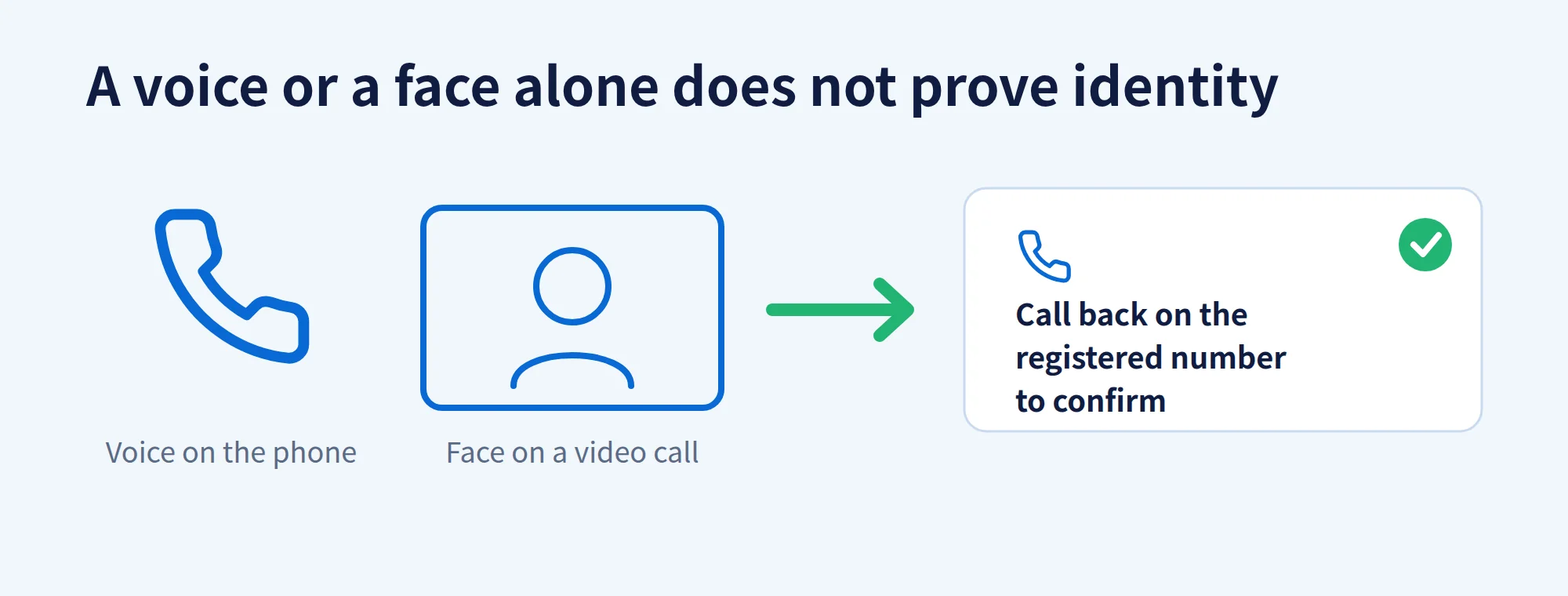
On a page updated 18 November 2026, the Tokyo Metropolitan Police Department describes patterns that use AI deepfake technology (voice synthesis and deepfake video) to impersonate police officers, company staff, relatives and others over phone and video calls. Because voice quality, way of speaking and even facial video are reproduced realistically, the police state that the old assumption — "if I hear the voice, I will know it is them" — no longer holds.
IPA's Top 10 Threats 2026 commentary also records that AI deepfakes and similar are used for impersonation, and that when impersonating an authoritative third party outside the company, such as a lawyer, fake phone calls using generative AI and similar may be used.
Overseas, there are cases published by public bodies. According to the Hong Kong government's written answer to the Legislative Council on 26 June 2024, in a case the police accepted at the end of January that year, a fake email impersonating the head office's Chief Financial Officer (CFO) arrived, and an employee invited to a group video conference approved transfers to five bank accounts as instructed, resulting in a loss of about HK$200 million. The Hong Kong Police believe the conference was a pre-recording made from publicly available video and audio on the internet. The same answer also touches on a case in May 2024 in which "the CFO" instructed a transfer of about HK$4 million in a video conference of about 30 minutes. Both were under investigation at the time.
In this research, no public figure could be confirmed showing how much damage from deepfake-based CEO impersonation has occurred inside Japan. For that reason, this article does not state a frequency. The Tokyo Metropolitan Police Department's countermeasure, however, is useful regardless of frequency: re-confirm important instructions and communications through the official, published contact point, and make "call back directly to confirm" an internal rule. Even if the voice on the phone sounds exactly like the person, and even if a face appears on a video call, do not proceed with a transfer or the submission of account information on that basis alone. On faked voices and video themselves, see also Is that really their voice? Preparing for AI voice and deepfake fraud.
Three rules to decide as a company: call back, two-person approval, never skip checks for "urgent"
Stop the pattern with internal rules, not by relying on the ability to spot it. The countermeasures listed by the National Police Agency, the Tokyo Metropolitan Police Department, IPA and LINE, organised into three. The form of the third — putting it into one sentence — is HIXOR's organisation.
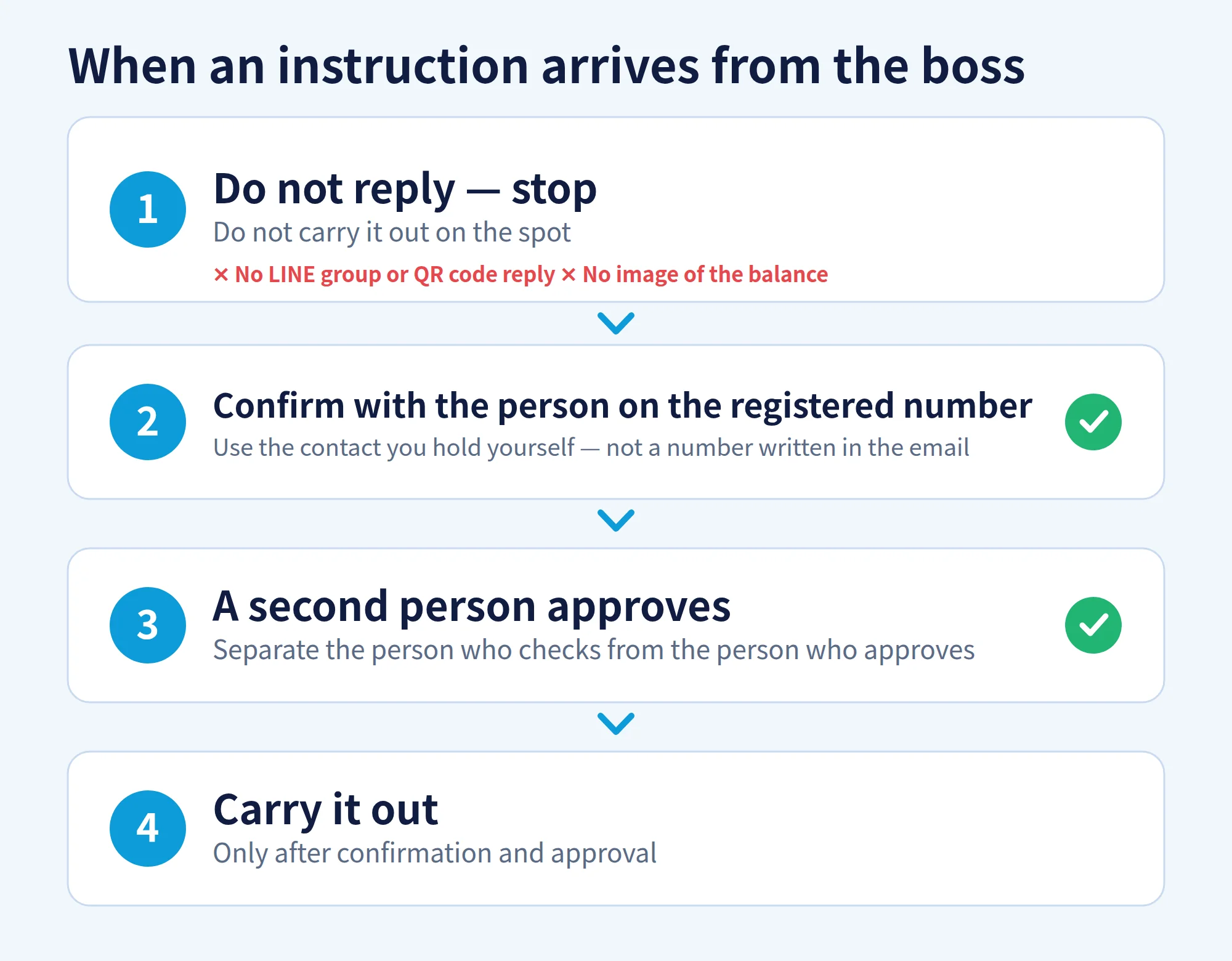
1. Call back on a registered contact, by a method other than email
- Do not reply through the means the instruction arrived by (email or LINE). IPA advises that when confirming with the person named as the sender, do not reply to the email received; confirm by another method such as a phone call. LINE's Help Center also asks that when a transfer or an urgent response is demanded, you confirm with the person or your manager by a means other than email (a phone call, in person, and similar).
- The contact to use is not a number written in the email, but one listed in your address book or on a business card (National Police Agency, Saitama Prefectural Police).
- The accounting staff should note down the phone numbers of the president and executives in advance. Without knowing the number, you cannot call back.
2. Transfers are checked and approved by two or more people
- IPA recommends creating an approval flow for transfer payments, such as a double check. The Top 10 Threats 2026 commentary also lists reviewing and approving payments by multiple people, never completed on one person's judgement.
- The approval flow is the same even for an instruction from the president personally. If the person instructing, the person carrying out, and the person confirming are separated, the pattern can be stopped even if one person is deceived.
3. Never skip confirmation because it is "urgent"
- The Top 10 Threats 2026 commentary recommends deciding the flow for confirming authenticity in advance, because patterns demanding urgent handling can occur.
- What you decide is the single sentence: "however urgent it is, the confirmation procedure does not change." With that sentence, the person in charge can say "I am confirming because those are the rules." Decide as a company, too, that the president and managers will not say "the confirmation can wait" themselves.
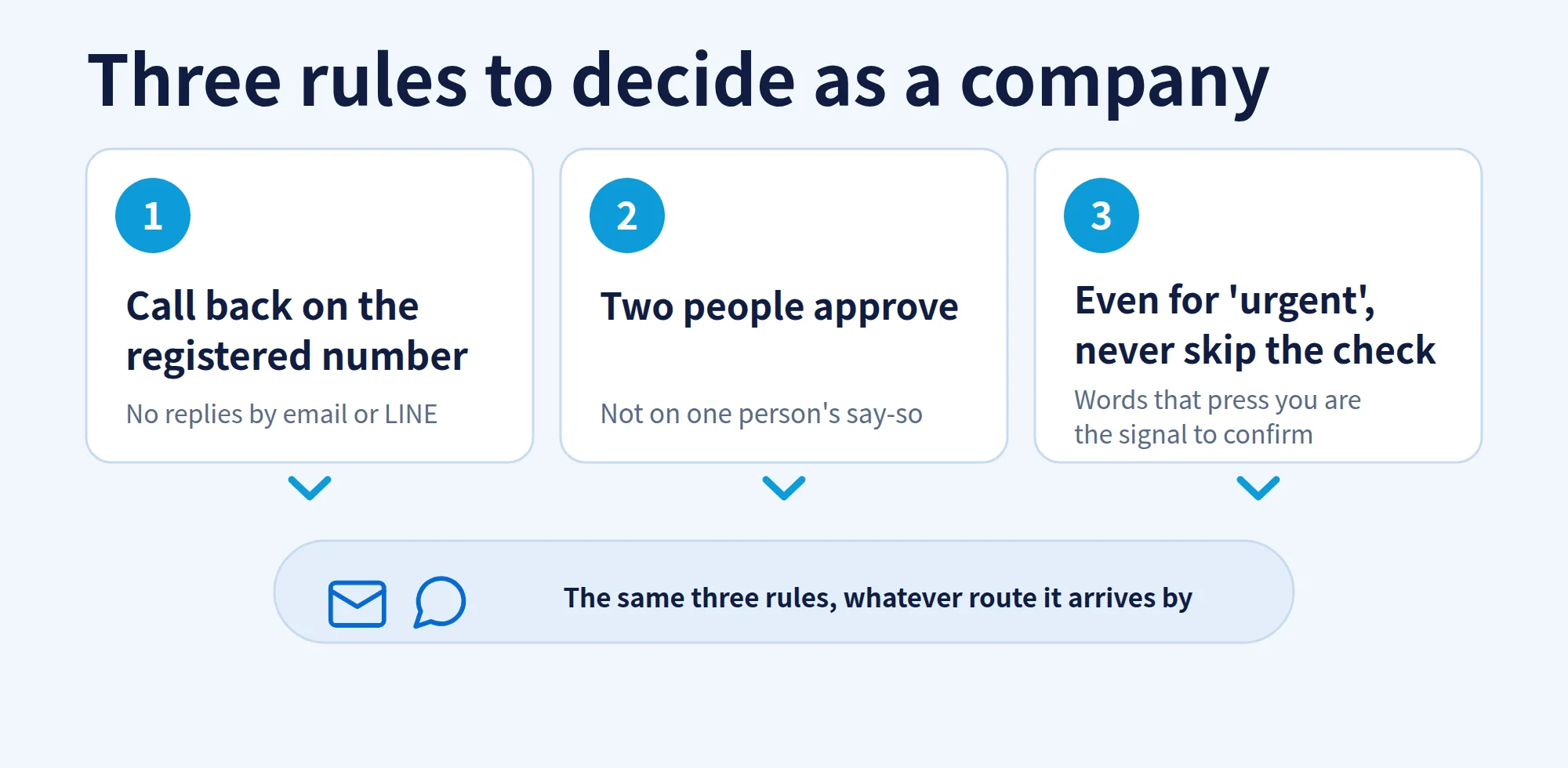
Once the three rules are decided, tell everyone in the company. The National Police Agency calls for sharing information about this kind of case inside the company and re-confirming the rules concerning transfers.
When told to "create a group" or "send an image": what never to send
With the LINE group pattern, you can stop your hand before talk of money and accounts begins inside the group.
- If creating a LINE group, or sending back a QR code, is requested by email, do not reply; confirm with the person by a separate means (LINE). The National Police Agency calls for care when instructed to use an SNS group.
- Do not send account information, personal information, or images of balances (LINE).
- Suspicious messages can be reported through LINE's report function (LINE).
When a suspicious email arrives: delete, report, share
IPA lists the following points for handling a suspicious email when you receive one.
- Ignore and delete suspicious emails. When you cannot decide, consult the department in charge of systems or the people around you
- If you confirm with the person named as the sender, do not reply to the email; confirm by another method such as a phone call
- Do not access URLs in the body, and do not open attachments
- If your company has rules for when a suspicious email is received, report following those rules
As everyday readiness, IPA lists creating a reporting procedure for suspicious emails inside the company and actually operating it, creating an approval flow such as a double check for transfer payments, and telling the whole company about cases like this one and carrying out education. The reporting procedure is summarised in Suspicious email: from spotting it to reporting it.
If you already followed the instruction: stop, and tell the company
If you only created a LINE group and sent the QR code. Among the examples that reached IPA's consultation desk, there was one in which a person followed the instruction while out, sent the QR code, grew suspicious at the stage of having sent it, deleted the group, and reported it to the company. IPA advises telling the company's security staff and issuing a warning, because the same email may have reached other people in the company, or an email instructing people to join the created group may arrive.
If you sent account information, or already sent money. The National Police Agency advises the following for cases of business email compromise damage.
- Ask the sending bank, at once, to carry out the procedures for cancelling the transfer or for a recall.
- Save the emails and email header information received from the attacker, and organise the sequence of events in time order.
- Take the emails sent by the attacker and report to and consult your nearest police station. Arranging the officer in charge, the date and time, and the materials by phone in advance makes the response go smoothly.
- Run a virus check on the PC, change the email account password, and check whether there are unauthorised forwarding settings or similar.
If you are anxious, you can consult the police consultation line, #9110 (National Police Agency). IPA notes that among the cases it has confirmed, there are both cases where the money was recovered and cases where it was not, and that recovery is not always possible. Where to consult is organised in Who do you call after a cyber incident in Japan? It depends on the problem.
Checklist for when an instruction arrives
When you receive an instruction in the name of the president or a manager, check the following before carrying it out.
- It asks for one of: a transfer, account information, an image of a balance, creating a LINE group, sending back a QR code
- I have not replied through the means the instruction arrived by (email, LINE, phone)
- I checked whether it contains words such as "urgent", "keep this from the others", "do not let anyone else in"
- I confirmed with the person directly, by phone or similar, using a contact from a business card, the address book, or the internal directory
- I also told the people in charge around me the result of the confirmation
- A second person in charge approved
- When I could not confirm, I stopped without carrying it out
If even one item cannot be confirmed, do not carry it out; wait until confirmation is obtained.
Making it easier to say no: example phrases
It is natural to feel hesitant about doubting "an instruction from the president". That is exactly why you make it sayable not as an individual's judgement, but as a company rule. The following phrases are examples HIXOR has devised; they are not the wording of any public body.
- "Before a transfer, the rule is that I call back on the registered number to confirm. Please give me a moment."
- "Just to be safe, I am having another person in charge confirm as well."
If the president personally tells the company in advance the policy that even when an instruction turns out to have been genuinely from the president, the person who confirmed will not be blamed, the people in charge can act more easily.
Check your own company's readiness
The state of your company's approval and confirmation rules can be checked with the free security self-check tool, from 25 questions. Answers are processed only inside your browser and are not sent to a server. Among the questions is an item asking whether you have a rule not to judge notices about invoices and payment-details changes by email alone, but to confirm by another means such as a phone call.
If you want teaching materials for sharing inside the company prepared as a set, the manager course in Security Training in a Box includes points to note for requests from suppliers and for approvals, and a funds-flow diagram of transfer fraud.
If you want a third party to organise your company's current state, there is the Security Assessment (¥30,000 excl. tax; ¥33,000 incl. tax). Based on your answers to an online assessment sheet, it delivers improvement proposals with priorities attached. The assessment is an organisation of your situation based on your answers; it does not include checking device settings or doing configuration work. Nor does it guarantee that no incident will occur.
Next step: make one sentence of confirmation a company rule
Readiness against CEO impersonation fraud is not special equipment; it is writing the three rules — "call back on the registered number", "two people approve", "never skip confirmation for 'urgent'" — onto a single sheet of paper, and having the president personally communicate them inside the company. What you can do today: have the accounting staff note down the phone numbers of the president and executives.
The order in which to advance company-wide measures is summarised in Small business cybersecurity: where to start. As readiness against account takeover itself, the order for introducing multi-factor authentication across a company is summarised in Multi-factor authentication for small companies: the rollout order.
Check your understanding
Q1. An email arrived in the president's name: "For a business project, create a LINE group and send back the QR code." The sender's address was a free-mail address. What do you do?
Answer: Do not reply, and do not send the QR code. Confirm with the president by another method, such as a phone call, using a registered internal contact — or tell the internal reporting contact or the people in charge around you. When you cannot decide, do not carry it out; consult.
Q2. On the phone, the voice sounded exactly like the president, asking you to "send the money right away". If the voice is genuine, may you send it?
Answer: A voice alone does not prove identity. The Tokyo Metropolitan Police Department describes impersonation using AI voices and video. Hang up once, call back on the registered number to confirm, and carry it out only after two or more people have approved.
Q3. You were told "it's urgent, and keep this from the others". Why is it better to tell the people around you?
Answer: Because pressing you and silencing you are features of this pattern, taking away the time for confirmation and consultation (IPA, Top 10 Threats 2026 commentary; LINE Help Center). If you consult the people around you, the chance of noticing the fake rises.
Review your current posture with 25 questions. Runs in your browser only.
See the latest threat intelligence