 HIXOR
Asked by a customer about your security measures? How to answer a questionnaire honestly — including how to explain what you haven't done, and how to build the evidence
Key points
- That a customer asks your company to take security measures does not, in itself, immediately raise an Antimonopoly Act problem — so the Ministry of Economy, Trade and Industry and the Fair Trade Commission have set out. Questionnaire formats differ by customer, so build an 'answer file' that explains your company's state once, and reuse it
- Answer 'yes', 'partly' or 'no', and add the scope and the evidence. For items you have not done, do not hide them: write 'not yet done' and add a plan or a substitute measure. Requests that cost money are a subject for price discussions
- Under the national SCS evaluation scheme (★3/★4), as of 29 November 2026 you cannot yet apply for registration; applications are planned to open in March 2027. It is a different scheme from SECURITY ACTION (★/★★): SECURITY ACTION is a self-declaration — not a certification, and not proof that you meet a customer's questionnaire
- Build the evidence as lists, rules and records, based on the IPA's free templates (basic policy, self-assessment, sample rules)
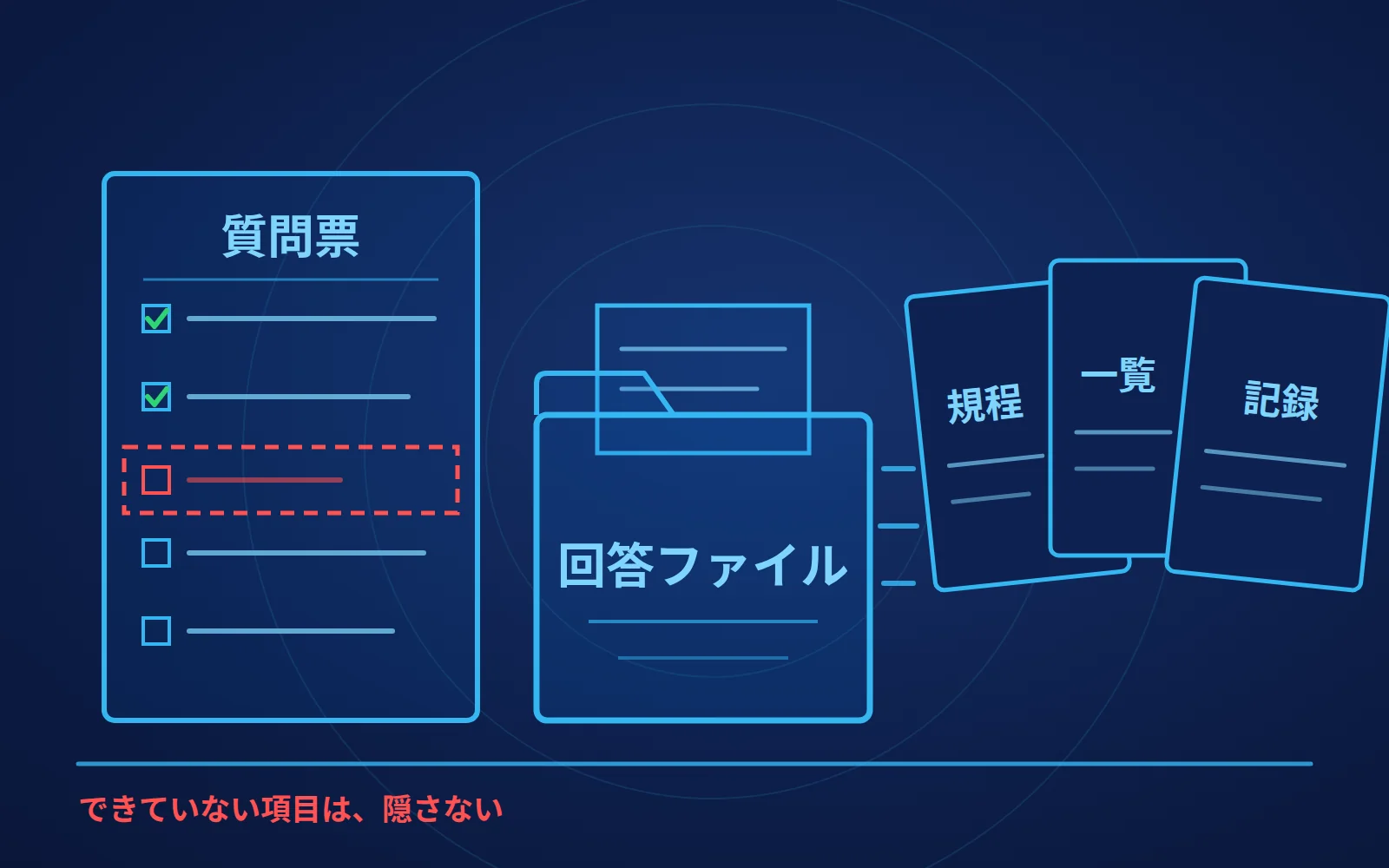
When a customer asks you to "tell us about your security measures", start by answering each item they ask about with "yes", "partly" or "no", and add the scope and the evidence. For anything you have not done, do not hide it: write "not yet done" and add your plan, or the substitute measure you use instead. Then, so that you can reuse the same evidence again and again, build an "answer file" once. This article explains what buyers ask, how to answer honestly, how to explain the items you have not done, how to build the evidence, and where the national "SCS evaluation scheme" and SECURITY ACTION sit in all this. One thing first: none of the national schemes in this article is a "certificate that makes you safe".
It is not unusual for a customer to ask about your security measures
The Ministry of Economy, Trade and Industry (METI) and the Japan Fair Trade Commission have set out that a buying company asking its trading partners to take cybersecurity measures does not, in itself, immediately raise an Antimonopoly Act problem (document updated 26 December 2025). The reason: if one company anywhere in a supply chain (the chain of transactions) is attacked, the damage can spread to its trading partners.
On the other side, being asked for different measures, in different formats, by several different customers — that is the small company's problem. METI lists being required to take various different measures by different customers as one of the reasons for creating the scheme (announcement of 27 March 2026). The method in this article is: "whatever the format, keep the material you answer with in one place."
What you will be asked: every company's questionnaire is different. The national common ruler is the "seven areas"
No reliable statistics showing which questions are asked most were found in the official material checked on 29 November 2026. Questionnaires differ from customer to customer. So this article uses the common ruler the national scheme provides to organise the areas you are likely to be asked about.
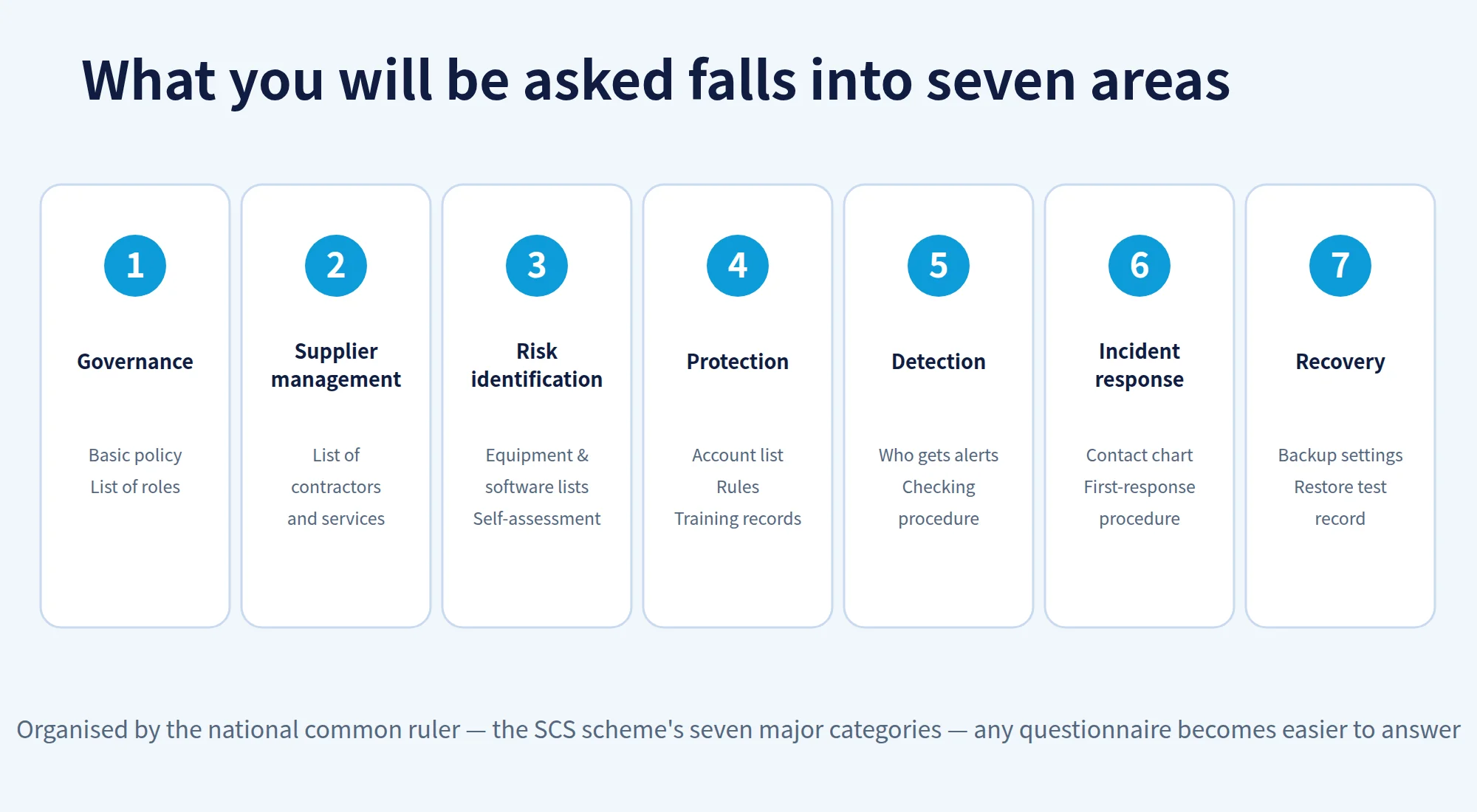
The SCS evaluation scheme, run by the IPA, organises its requirements into 7 major categories and 16 sub-categories (★3 has 26 items; ★4 has 43 items). The table below takes those 7 major categories and adds HIXOR's "example questions" and "material to prepare". The example questions are not the wording of any real questionnaire; they are HIXOR's own organisation.
| SCS major category | Example question (HIXOR's organisation) | Material to prepare |
|---|---|---|
| 1 Governance | Do you have a person responsible for security, and a basic policy? | Basic policy; list of the responsible person and roles |
| 2 Supplier management | Do you keep track of your contractors and cloud services? | List of contractors and services in use |
| 3 Risk identification | Do you keep track of the equipment and software you use? | Lists of equipment, software and cloud services; your self-assessment results |
| 4 Protection against attacks | Account management, multi-factor authentication, updates, training, data protection? | Account list; rules; training records |
| 5 Detection of attacks | Do you have a way to notice something abnormal, and someone who watches? | Who receives alerts, and the procedure for checking them |
| 6 Incident response | Do you have contacts and a procedure for when an incident happens? | Contact chart; first-response procedure |
| 7 Recovery from incidents | Do you take backups, and can you restore from them? | Backup settings; a record of having tested a restore |
In the IPA's material, of ★3's 26 items, the area "identity management, authentication and access control" accounts for 7 items — the most of any area. Account and authentication management is likely to be asked about by any customer (this is HIXOR's inference, not an official statistic). How to roll out multi-factor authentication is covered in Multi-factor authentication for small companies: the rollout order.
Two schemes with similar names: the SECURITY ACTION stars and the SCS evaluation scheme stars
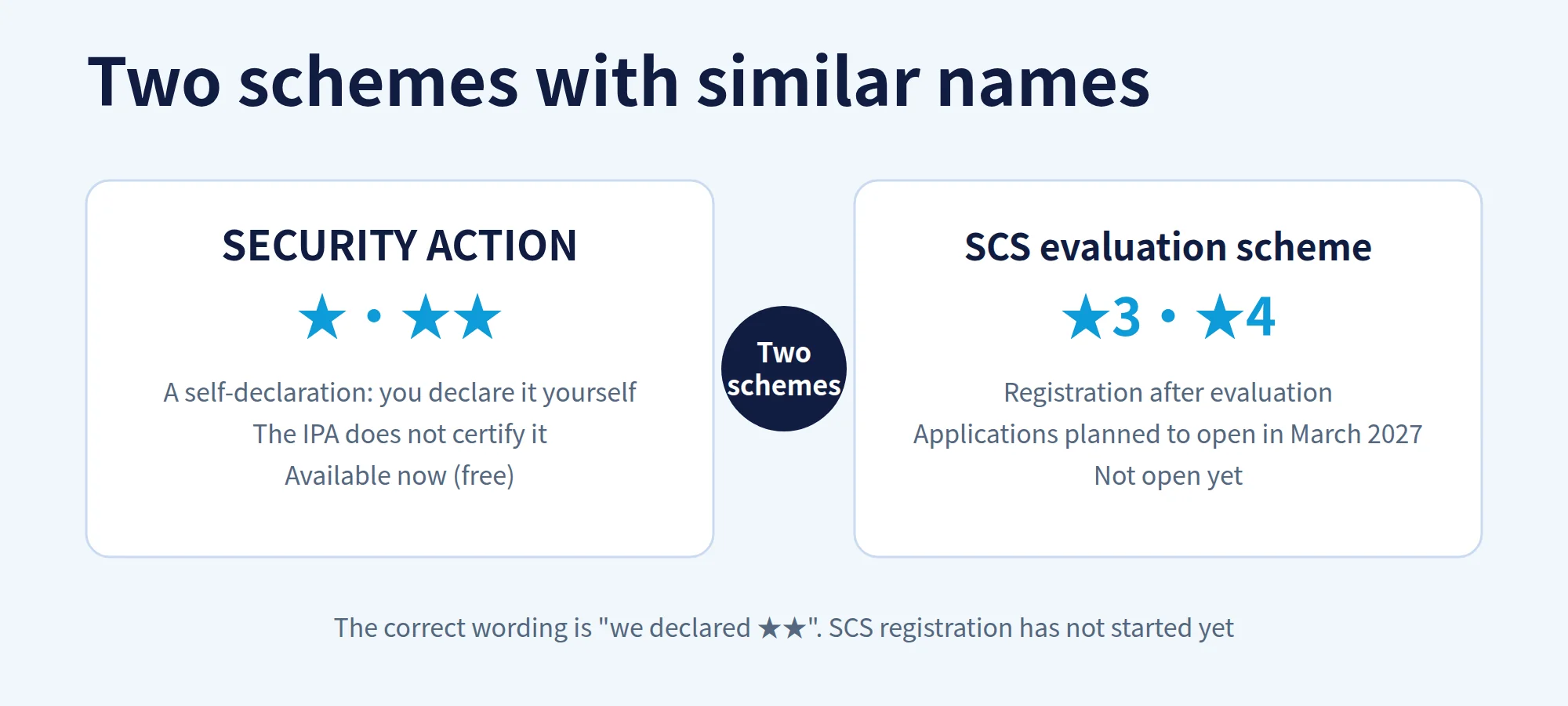
One confusing point to clear up first. Both schemes use "★", but they are different schemes.
| SECURITY ACTION | SCS evaluation scheme | |
|---|---|---|
| Run by | IPA | METI and the National Cybersecurity Office (Cabinet Secretariat) published the policy; the IPA runs the scheme (27 March 2026) |
| Levels | ★ (one star), ★★ (two stars) | ★3, ★4 (★5 is under consideration; no start date has been set) |
| How it works | A self-declaration: you "declare" it yourself. The IPA does not certify it | "Registration" after evaluation. ★3 is a self-assessment checked by an expert, plus a declaration by management; ★4 is a third-party evaluation |
| Can you do it now? | Yes (free) | Registration is not open yet. Applications are planned to start in March 2027 |
About SECURITY ACTION, the IPA states clearly that it "is not the IPA certifying the state of your information security measures". Writing "we obtained ★★" or "we were certified" is inappropriate wording; the correct wording is "we declared ★★". The steps for declaring are set out in SECURITY ACTION One Star and Two Stars: How to Declare and What to Prepare.
A declaration can serve as material for telling a customer "we are working on this". The METI / Fair Trade Commission document also says that efforts to include the presence or absence of a declaration as a condition in private transactions are "expected". However, having declared does not prove that you meet each individual item on a customer's questionnaire. On a questionnaire, you answer the actual state of affairs, item by item.
How far has the SCS evaluation scheme got? (as of 29 November 2026)
The SCS evaluation scheme is a scheme whose "scheme design policy" was published on 27 March 2026 by METI and the National Cybersecurity Office of the Cabinet Secretariat. It envisages two-company transactions in which the buying side shows the supplying side a ★ level, encourages them to implement the measures, and checks the state of implementation. It is not a ranking designed to make companies compete, the policy says. As confirmed on the official IPA and METI pages on 29 November 2026:
- The scheme is voluntary. Whether to make obtaining a ★ a condition of trade is decided by the parties to the contract. The scheme itself does not oblige anyone (IPA FAQ, updated 30 October 2026)
- Not meeting everything does not mean trade stops immediately. The IPA FAQ explains that not meeting the requirements is not, in itself, grounds for trade to be stopped immediately. It also envisages using the requirements as a "common checklist" to check the state of measures, not only obtaining a ★
- To obtain a ★, you must meet all of the requirements. You cannot take a level by meeting only some of them (FAQ)
- Registration applications are planned to start in March 2027. On 28 October 2026 the IPA published the requirements and evaluation criteria (Ver. 1.1) and the self-assessment guides. The list of evaluation bodies is planned for publication in late December 2026, and the SCS security experts in January 2027 or later. The IPA's explanatory material (September 2026) notes that if preparations are delayed, the start date may be revised
- The registration fees are ¥20,000 per year for ★3 and ¥60,000 for three years for ★4. For ★3, a discount applies until 31 March 2028, making it ¥10,000 per year. Whether this amount includes the cost of the expert's check for ★3 or the third-party evaluation for ★4 could not be determined from the material confirmed on 29 November 2026
- A ★ is not a guarantee of complete safety. The IPA's explanatory material states that obtaining a ★ shows that, at the time of obtaining or renewing it, the organisation met a defined standard, and does not guarantee that complete security against incidents is assured
- The "registration application guide" is announced as planned for publication around the end of November 2026, but as of 29 November 2026 its publication could not be confirmed on the IPA's pages. Decide how to apply once it can be confirmed
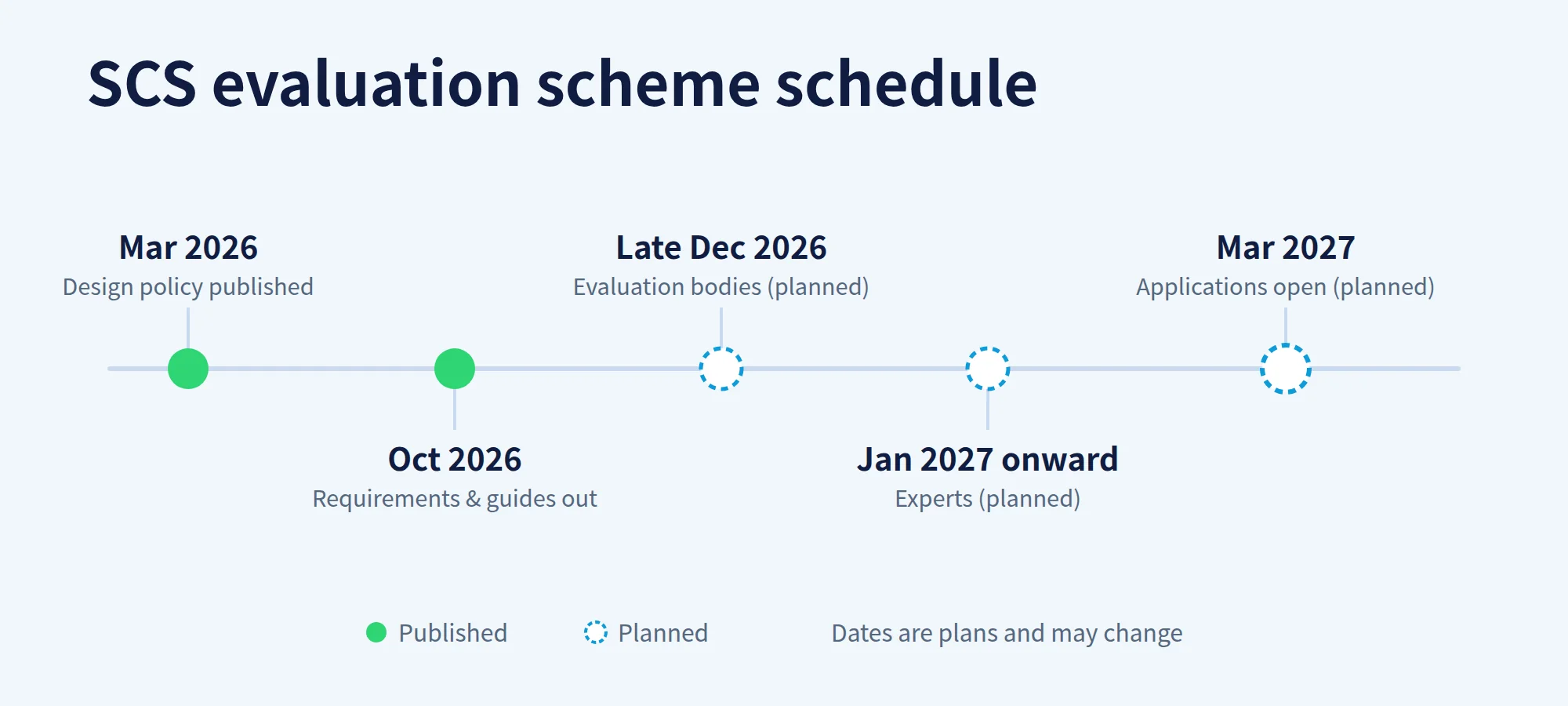
In other words, there is currently no company that can write "we have obtained ★3" or "we comply with ★4". If a customer asks you for "measures equivalent to ★3", check whether they are asking for "registration at ★3" or for "measures in line with the ★3 requirements".
Beware of inappropriate sales pitches trading on the SCS evaluation scheme
On 27 April 2026, METI and the National Cybersecurity Office called attention to sales activity trading on the SCS evaluation scheme — pitches such as "if you don't obtain an evaluation, your trading will be regulated" or "if you don't obtain one right away, you'll be excluded from bidding" — as contrary to the purpose of the scheme. The scheme does not regulate individual companies' trading, and it does not make the introduction of any specific security product mandatory. If you receive a sales pitch that plays on anxiety, check the IPA's official pages.
Answer honestly: "yes", "partly", "no" — with scope and evidence
Your answers on a questionnaire concern the trust between you and your customer. If you answer something that differs from the facts, the customer will make its trading decisions based on that answer. What an answer means contractually depends on the terms of the contract. If you are concerned, check the contract or consult a specialist. This article makes no legal judgements.
Keep to the following three points and you will not go far wrong.
- Answer "yes", "partly" or "no". Avoid wording that leaves things unclear, such as "broadly" or "basically"
- Write the scope. "Whole company", "head-office PCs only", "accounting email only" — write how far the answer reaches
- Attach evidence. Name things you can show later: a rule's name, a list, a settings screen, a record. If you cannot show it, write that
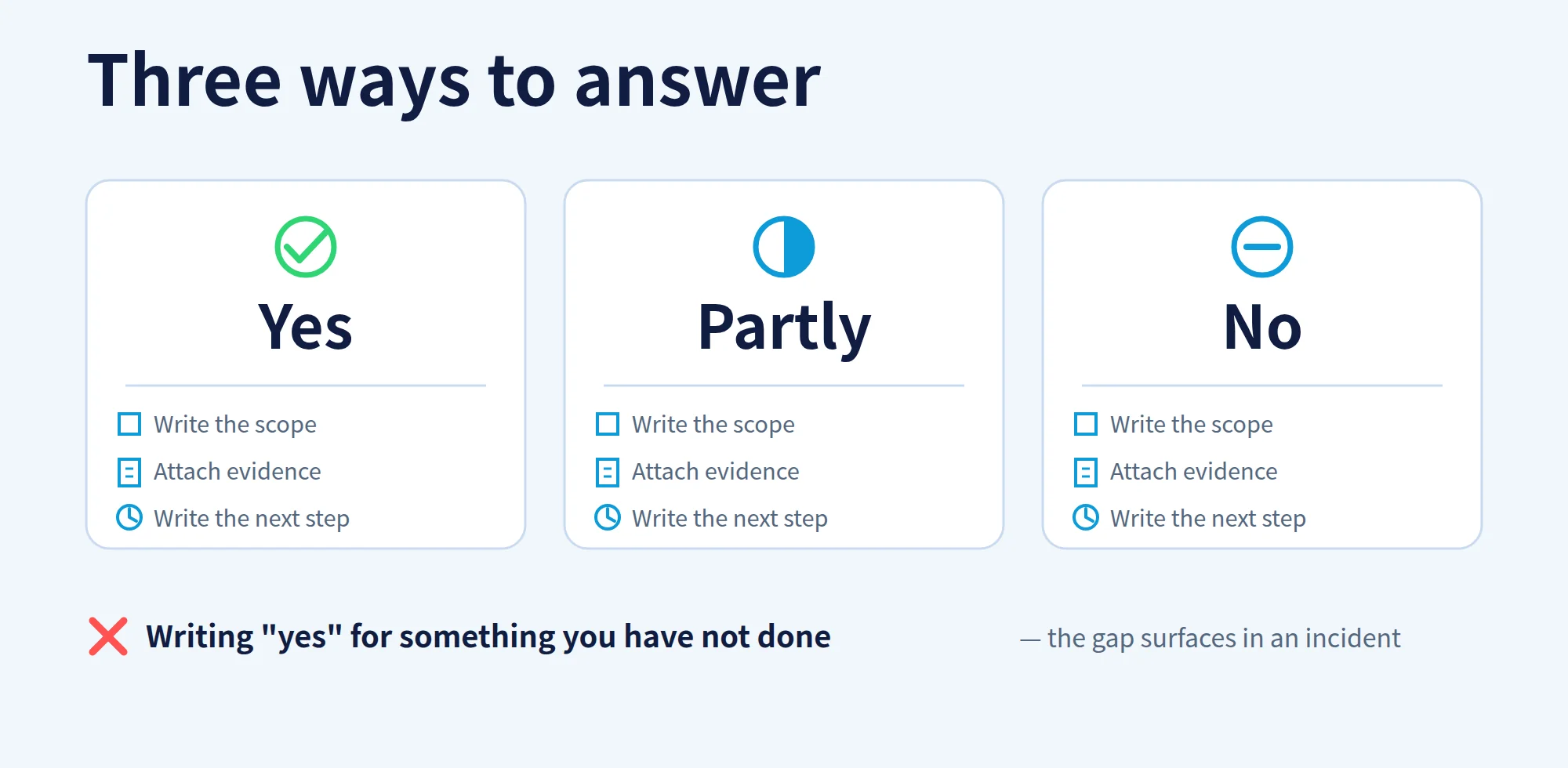
Examples of answers (company names and figures are fictitious).
- Yes: "Multi-factor authentication is set on email and on the cloud accounting service (all staff, including 2 administrators). The state of settings is recorded in the account list"
- Partly: "Backups are taken daily. Restore testing has not been done yet. We will set a date we can actually keep, carry out a restore test, and record the result"
- No: "We do not yet have information security rules. We are preparing a basic policy and the main rules based on the IPA's samples, and will share them when complete"
Even with "partly" or "no", if the current state and the next step are written down, the customer can grasp the situation. Conversely, if you write "yes" for something you have not done, the difference between the answer and reality will surface when an incident happens, or when the customer comes to check. For an item you don't know, write "we will answer after checking" and give a date. For SECURITY ACTION and the SCS stars, keep to the wording above ("we declared"; and "we registered" only once registration is actually possible and done).
When you haven't done it: don't hide it — proceed by priority and by asking
If some items on the questionnaire are things you haven't done, there is no need to panic. Proceed in this order.
- Write "not yet done". Do not leave it blank, and do not answer vaguely
- Add a plan and a substitute measure. Write only dates you can actually keep. For an item you cannot do right away, write the substitute measure (for example, checking by hand until a system is introduced)
- Ask the customer. "Is this item mandatory?" "For the time being, would a substitute measure be acceptable?" "Are you asking for a specific product, or for the substance of the measure?" The SCS evaluation scheme itself also does not make any specific security product mandatory
- Set priorities inside your own company. You do not have to fix all the "no" items on a questionnaire at once. Start with the ones with the greatest impact. How to proceed is set out in Small business cybersecurity: where to start
- If a request costs money, discuss it. The METI / Fair Trade Commission document gives, as examples of conduct that may raise an Antimonopoly Act problem: setting prices unilaterally without considering the increased cost of implementing measures, and keeping prices as they were without discussing them in price negotiations after the request. It also says that a customer making you use products or services it designates, without reasonable necessity, may be a problem. The buying side is expected to actively provide opportunities for price negotiation. If you receive a request you find hard to accept, the IPA's material introduces consultation routes such as the "Torihiki Kakekomi-dera" (a consultation service for subcontractors) and the Fair Trade Commission's consultation system. Whether something is legally a problem depends on the actual circumstances of the transaction. This article makes no judgement; it only points to where you can consult
Build the evidence: make an "answer file" once, and reuse it
Searching for evidence from scratch every time a questionnaire arrives is a heavy burden. Build a file like the following once, and you can use it for every answer. The IPA's "SME Information Security Guidelines", 4th edition (published 27 March 2026), comes with ready-to-use templates as appendices.
| Material | What to make | Usable template (IPA, free) |
|---|---|---|
| Policy | Information security basic policy (1 page) | Appendix 2: Information security basic policy (sample) |
| Picture of the present | Results of a self-assessment (25 items) | Appendix 3: "5-minute information security self-assessment" (also available as an Excel file) |
| Rules | Information security rules | Appendix 5: Information security rules (sample). Includes a correspondence table with the ★3/★4 requirements of the SCS evaluation scheme |
| Lists | Equipment, software and cloud services; accounts; contractors | Make your own (see "material to prepare" in the table above) |
| Records | Training carried out; restore tests; stopping leavers' accounts | Make your own. Keep the date and the person responsible |
You can also use the requirements themselves as a checklist. The IPA publishes the "self-assessment guide" for ★3/★4 and the assessment sheet (Excel) used for self-assessment (28–29 October 2026). Even with no plan to register, you can use them to review your company's state against the national common ruler.
Three points to watch when making records.
- Do not let secrets appear in screenshots. Hide passwords, personal information, customer information, internal addresses and the like
- Put the date and the author on it. Old records are weaker as evidence
- Match the documents to actual practice. If what the rules say is not being done, the answer and the reality will differ. Keep the content to what you can actually keep, and review it
For training records and incident contact points, the following articles are useful: Employee security training for small companies: what, how often, and Incident response cards: what prepared small businesses have ready before an incident.
An example four-week schedule (HIXOR's example — not an official yardstick)
| Week | What to do |
|---|---|
| Week 1 | Sort the questionnaire you received into the seven areas, and provisionally write "yes / partly / no". Ask the customer which items are mandatory, and whether a grace period or substitute measures are acceptable |
| Week 2 | Make the lists: equipment, software and cloud services; accounts; contractors. Write the basic policy (1 page), based on the sample |
| Week 3 | Choose one "no" item with a large impact and implement it. Decide the dates for training and for a restore test |
| Week 4 | Put the answer file in order and answer the questionnaire. For "partly" and "no" items, write the plan |
Checklist before you answer
Before sending your answers, check each item.
- Read the questionnaire items, sorted into the seven areas
- Wrote "yes", "partly" or "no" for each item, with the scope
- For "yes" and "partly", there is evidence you can show (lists, rules, records)
- For "no", wrote a plan or a substitute measure — with a date you can actually keep
- Checked with the customer which items are mandatory, and whether a grace period or substitute measures are acceptable
- For SECURITY ACTION, wrote "we declared" — not "certified" or "obtained"
- For the SCS evaluation scheme stars, did not write "obtained", because registration is not open yet
- For requests that cost money, checked how the cost is viewed in the price discussion
- Removed passwords and personal information from screenshots
Check your own company's state
First, you can check your company's situation with the free security self-check tool, through 25 questions. It asks about "separating administrator accounts", "two-factor authentication (MFA)", "knowing your shared accounts", "the procedure for stopping accounts when someone leaves or moves", and "rules for confirming bank-detail changes". Answers are processed only inside your browser and are never sent to a server.
If, before answering a customer, you want a third party's eye to organise the state of your measures, there is the Security Assessment (¥30,000 excl. tax; ¥33,000 incl. tax). Based on your answers on the online assessment sheet, it organises your current state and provides improvement proposals in priority order and a 90-day improvement plan. You can see the shape of the report in the sample report (an example for a fictitious company).
However, the Security Assessment is an organising exercise for understanding your current state and preparing your answers. It is not an evaluation or check under the SCS evaluation scheme, and it is not a substitute for ★ registration or for a SECURITY ACTION declaration. It does not grant any official certification. The assessment is an organisation of the respondent's own answers; it does not include checking equipment settings or vulnerability scanning. Nor does it guarantee that you meet a customer's questionnaire, or that no incident will occur.
Next step: first, sort the questionnaire into the "seven areas"
Two things you can do today. If a questionnaire has arrived from a customer, sort each item into the seven areas. And mark the items that look like they will be a "no". From there, check with the customer whether they are mandatory, set your priorities, and proceed. For the order in which to advance your company-wide measures, see Small business cybersecurity: where to start.
Check your understanding
Q1. A customer has told you, "Please obtain ★3 of the SCS evaluation scheme." Can you obtain it now?
Answer: As of 29 November 2026, you cannot yet apply for registration. The IPA plans to open applications in March 2027, and the start date may be revised. Check with the customer whether they are asking for "registration at ★3" or for "measures in line with the ★3 requirements".
Q2. You have declared ★★ under SECURITY ACTION. On a questionnaire asking "Do you implement information security measures?", may you write "Yes (★★ obtained)"?
Answer: Do not write that. SECURITY ACTION is not something the IPA certifies; it is a self-declaration. Write "we declared ★★", and for each item on the questionnaire, answer the actual state of affairs, with scope and evidence.
Q3. A questionnaire item asks whether you have information security rules. You don't have any. How do you answer?
Answer: Write "no", and add a plan and a substitute measure. For example, "in preparation, based on the IPA's samples", with a date you can actually keep. Also check with the customer whether that item is mandatory.
Review your current posture with 25 questions. Runs in your browser only.
See the latest threat intelligence