 HIXOR
Incident response cards: what prepared small businesses have ready before an incident
Key points
- Incident response cards are the first-response procedure — who does what, in what order — split into one printable card per role
- The difference preparation makes is not knowledge: it is whether anyone must search for the procedure during the incident
- The IPA publishes a free incident response guide for small businesses; companies that can adapt it themselves may need nothing more
- A ready-made card set fits companies with no dedicated IT staff, where preparation stalls at designing the forms
Incident response cards are your first-response procedure — who does what, in what order — printed as one card per role, ready to grab when something happens. The difference between a prepared company and an unprepared one is not knowledge. It is whether anyone has to go looking for the procedure during the incident. To be straightforward: Japan's IPA publishes a free incident response guide for small businesses, and for some companies that guide alone is enough to build the framework. This article sets out honestly which companies need nothing more, and which are better served by a ready-made card set.
What incident response cards are
A security incident is an event that harms the business through information: a data leak, tampering, a virus infection, a system outage. The IPA's incident response guide for small and medium enterprises organises the response into basic steps: detection and receiving reports, first response (isolation and disconnecting from the network), reporting and disclosure, then investigation and recovery.
Incident response cards take those steps and split them by role and moment: a card for the person who discovers the problem, a card for the owner (decisions and setting up the response), and cards for device isolation, the contact list, evidence preservation, and external communication. The point is not a thick manual. It is that the first hour's actions are visible at a glance, even to someone who is panicking.
The first hour in a prepared company
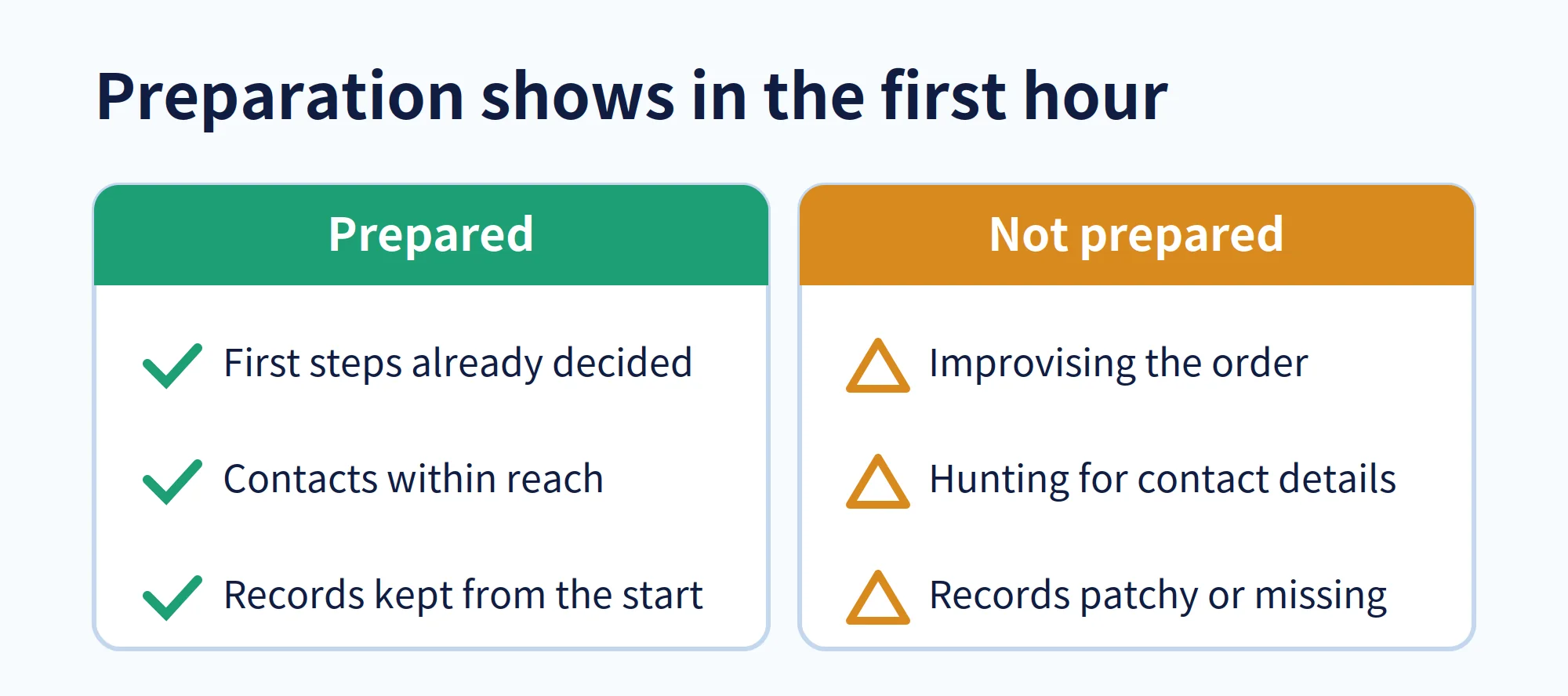
In a prepared company, the moves are already decided. The discoverer reports to a named contact, the manager escalates to the owner and stands up the response, the affected device is disconnected from the network, and actions are recorded in time order. Judgements the IPA guide calls out — such as not carelessly cutting power and erasing records — are not debated on the day, because they are written down.
The other difference is that contact details are at hand. Police, the IPA, the Personal Information Protection Commission, your maintenance vendor, key business partners: if you start looking these up during an incident, the first hour is gone. Whether the contact list fits on one sheet directly affects how fast the response moves.
What tends to happen without preparation
In an unprepared company, delay comes from the missing procedure itself, not from bad intent or lack of skill. Someone helpfully reboots the machine and the logs needed for investigation disappear. Nobody knows who to report to, so time passes before the owner is even asked. Nothing is written down, so the accounts given to partners and authorities do not match. Each of these is avoidable with a thirty-minute conversation in peacetime.
Cards do not prevent incidents, and this article will not pretend otherwise. They cover how you move in the first hours after something happens — a different layer from preventive measures such as updates, password management, and backups. Judge whether you need them with that distinction in mind.
Building it from the free guide vs. buying a ready-made set
There are three broad options.
| Option | Cost | What it involves |
|---|---|---|
| Prepare nothing | Free | Procedure, contacts, and forms are all improvised during the incident. Slow first response and missing records are the usual result |
| Build your own from the IPA's free guide | Free (your time only) | The guide is written for small businesses and is a sound framework. You adapt contacts, roles, and forms to your own company yourself |
| Use a ready-made card set | Paid | Cards, timeline, and forms arrive already structured. You still fill in your own company details, but you do not design the forms from zero |
If your company has someone with the time to adapt the procedure in writing — or already has documented roles and a contact list — the free IPA guide may genuinely be sufficient. If the work stalls at "we don't know what the forms should look like," a ready-made framework moves you forward. HIXOR's Incident First-Response Cards & Runbook Pack (General Edition) is built for the second case: six first-response cards, a first-response timeline, a 12-chapter policy template, a report/notification decision-flow form, two tabletop exercise scenarios, a usage guide, and a contact-list card — 7 PDFs, 23 pages, plus Word and Excel files.
Supplementary (bundle): if you want staff training prepared at the same time as incident readiness, the Company Set (¥42,800, tax included) bundles this pack with the training kit. If you only need the first response in place, the card pack on its own is enough.
A quick way to decide
- The free guide is enough if — someone can own adapting the procedure to your company, and your contact list and roles are already written down
- A kit fits better if — there is no dedicated IT person, form-making is where preparation stalls, you want printed cards everyone can reach, or you want tabletop exercises included
- Either way, do this today — decide the contact list and "who do I tell first?" That costs nothing
For how incident readiness and staff training fit together, see small business cybersecurity: where to start. For the steps themselves when a ransomware screen appears, see ransomware: first steps for a small business.
About the kit mentioned in this article

Incident First-Response Cards & Runbook Pack (General Edition) — ¥19,800 (tax included)
Six first-response cards (discoverer, owner, device isolation, contact list, evidence preservation, external communication), a first-response timeline, a 12-chapter policy template, a report/notification decision-flow form, two tabletop exercise scenarios, a usage guide, and a contact-list card — 7 PDFs, 23 pages, plus Word and Excel files. This article helps you decide whether to prepare; the kit removes the form-building work that comes after that decision.
See the shop guide for how buying, downloading, and printing work.
Review your current posture with 25 questions. Runs in your browser only.
See the latest threat intelligence